











For many women, the decision to have a child can bring an important question into focus: What will happen to my career if I step away from work to raise my child?
For those already considering a career change, another question often follows: If I want to reskill and move into a new industry, is it still possible at this stage of my career? Or have I already missed the right moment?
Pui has faced those questions. She did not find all the answers immediately, and her journey was neither clear nor predictable. Instead, she built her next chapter step by step, using skills gained from each previous role.
Today, Pui is a System Analyst, or SA, at Bluebik. Before joining the technology industry, she spent more than seven years as a flight attendant, gained experience as a secretary and in sales, became a full-time mother during the COVID-19 pandemic, worked as a content creator, and completed a full-stack programming bootcamp while managing school drop-offs, assignments, and family responsibilities.
Her career path has not been linear, but this diversity has shaped her into the professional she is today.
From Science Graduate to Cabin Crew: The First Career Pivot
Pui studied Science at Srinakharinwirot University, driven by her interest in biology, genetic engineering, and laboratory work.
She was drawn to the structured thinking involved in science: understanding how a system works, examining its individual components, and tracing the relationships between them.
After graduating, however, she became curious about a different career path. Inspired by her older sister, who worked as a flight attendant, Pui decided to explore the aviation industry.
At first, she was unsure whether cabin crew work would suit her. The role appeared very different from her academic background. However, she had developed strong English skills through a Work and Travel program, along with communication skills from working with people in a laboratory.
She believed these skills could be applied in a new direction.
“From the beginning, I have always enjoyed talking to people and learning new things. I never felt that I had to limit myself to the field I studied,” Pui said.
“When we take a new path, it does not mean we have to leave our previous skills and experiences behind. We can bring them with us and build on them as we learn something new.”
For Pui, working as cabin crew involved much more than service.
“People who have never worked as cabin crew may mainly see the soft skills or physical side of the role. In reality, being a flight attendant requires you to understand the entire operation and manage responsibilities across both service and safety. Each area also has its own depth,” she explained.
“It is similar to working in a laboratory, where we need to understand the overall picture while also looking more closely at individual systems or organs when studying biology.”
During her seven years as a flight attendant, Pui developed skills that continued to benefit her after leaving the aviation industry.
She learned to assess situations, communicate with diverse individuals, stay alert to changing conditions, and solve unexpected problems while maintaining a high-quality experience.
These skills later proved highly relevant to her role as a System Analyst.
Becoming a Mother with Intention
After seven years as a flight attendant, Pui began planning to have a child.
For her, becoming a mother required preparation in many areas.
“Having a child is not easy. You need to be ready financially, have enough time, and create an appropriate environment for raising a child,” she said.
“For me, emotional readiness was the most important factor. I had decided that I did not want to rely on a nanny. I wanted to raise my son myself, especially during his first three years, because children learn how to live from the people who raise them. That meant I needed to be genuinely ready.”
Her son’s first three years coincided with the COVID-19 pandemic. During that period, Pui devoted herself fully to raising him.
She also made it clear to her partner that becoming a full-time mother was not meant to end her professional career.
“One day, my son would start school, grow up, and have a life of his own. I also needed to continue living my own life,” she said.
“No matter what happened, I knew that I would return to work and continue building the career path I had planned for myself.”
When it was time to re-enter the workforce, Pui recognized that returning to cabin crew work might not support the life she wanted long-term. Age restrictions still exist in parts of the Asian airline industry, and she approached that reality practically.
Rather than waiting for the right opportunity to appear, she began exploring new possibilities.
During this transition, Pui worked as a content creator, focusing on motherhood and parenting, subjects closely connected to her everyday life.
The role allowed her to remain professionally active while developing new skills. She learned to understand an audience, identify what information mattered, shape messages for different contexts, and deliver content that met specific needs.
At the time, she did not yet know how relevant these skills would become in her future career.
Reskilling for a Career in Technology
During the COVID-19 pandemic, Pui became increasingly interested in the technology industry.
She could see its long-term growth potential and began researching how someone with her background could realistically enter the field.
Her search eventually led her to the Junior Software Developer Bootcamp offered by Generation Thailand, a nonprofit organization that supports career changers in developing technology skills in partnership with King Mongkut’s University of Technology Thonburi.
Pui carefully reviewed the curriculum, read feedback from previous participants, and completed interviews in both Thai and English. She was subsequently awarded a scholarship to join the program.
“It was exciting and challenging at the same time,” she recalled.
“I was still a full-time mother, so I had to make every hour count. I woke up early, took my son to school, returned home, and studied from 9:00 a.m. to 6:00 p.m. After that, I had assignments to complete and content work to manage.”
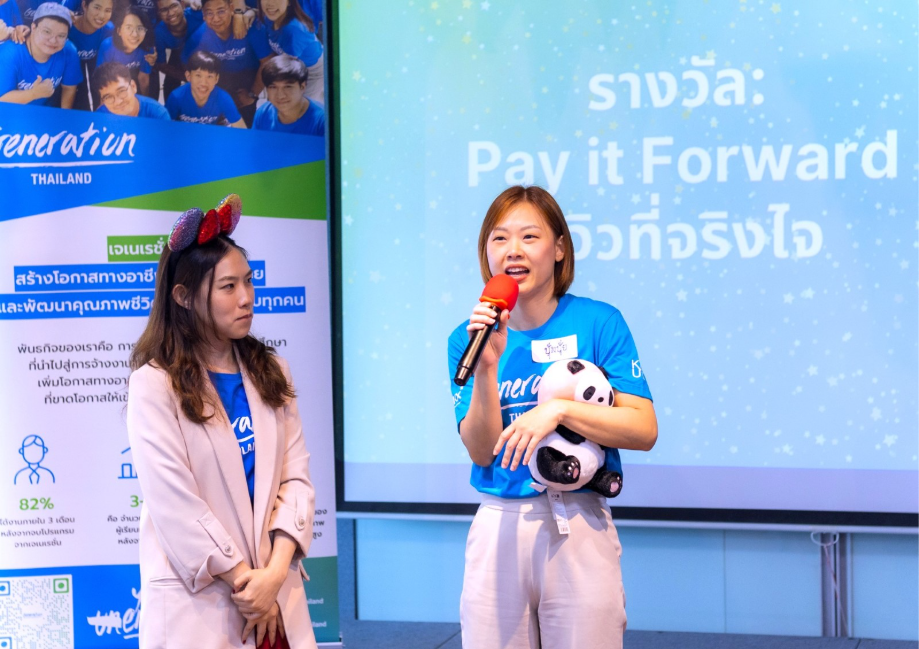
During the bootcamp, Pui studied full-stack programming and applied what she learned by developing projects based on areas she genuinely cared about.
One project was an e-commerce platform for children’s educational content. It was designed around the needs of teachers and parents, with a user experience that made the content easy to find, purchase, and download.
She also developed a well-being application that enabled users to record their emotions and manage their daily tasks.
These projects gave Pui more than an opportunity to practice technical skills. They also revealed how naturally she approached technology from the user’s perspective.
She was not interested in building a product simply because it could be built. She wanted to understand who would use it, what they were trying to achieve, and how the experience could be made more intuitive.
This combination of technical understanding and empathy for the end user would later become central to her role as a System Analyst.
Despite the intensity of the program, Pui remembers this period with pride.
“I was happy that I could inspire my son by showing him that his mother never stops learning,” she said.
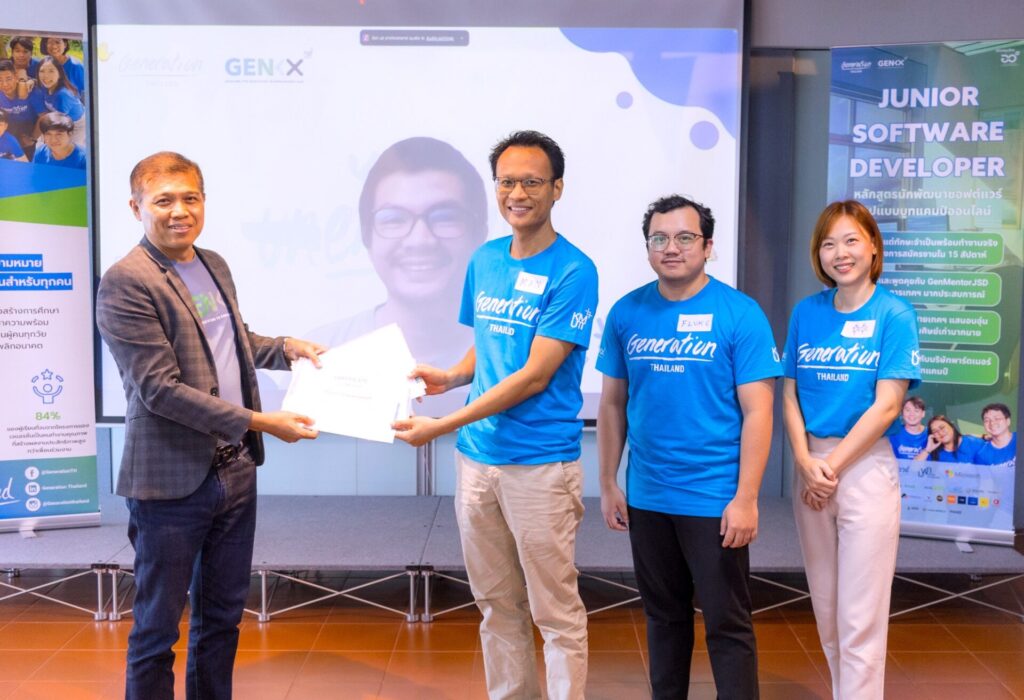
Completing the bootcamp was not the end of her learning journey. It became the beginning of a new one.
After joining Bluebik, Pui continued developing her skills through real client projects, knowledge sharing with specialists across the team, and exposure to a wide range of technology and business challenges.
This environment has helped her grow from someone entering a new industry into a System Analyst who can confidently contribute to client outcomes.
Joining Bluebik: An Opportunity Built Around Potential
After completing the bootcamp and developing her own projects, Pui learned about Bluebik and applied for a role.
The conversations she had during the application process helped her see how her previous experience could connect with a career in technology.
“What made me choose Bluebik was not simply that it was a technology company,” she said.
“At a time when I was changing careers, the company looked at my potential rather than focusing only on whether I had direct experience in the role.”
“Bluebik gives people who are ready to learn a genuine opportunity to prove themselves. From my first day, I also had senior colleagues who coached and supported me as I developed.”
Pui ultimately decided to pursue the System Analyst path rather than continue in a purely development-focused role.
Her understanding of both frontend and backend systems gave her a solid technical foundation. Her ability to communicate, understand different perspectives, and connect business needs with practical solutions gave her a natural advantage in the role.
A System Analyst must understand requirements, translate between business and technical teams, consider the overall system, and pay close attention to details that may affect the final user experience.
In many ways, this was not entirely new territory for Pui.
It reflected the same mindset she had developed during seven years as a flight attendant: understanding the whole operation, responding to the needs of different people, managing risk, and ensuring that the experience remains effective from beginning to end.
Today, Pui works with teams and clients on technology projects that require both technical understanding and thoughtful collaboration.
At Bluebik, consultants work closely with clients to understand their challenges, design appropriate solutions, and help ensure that those solutions can be implemented effectively within the organization.
For someone whose experience has always combined service, structured thinking, adaptability, and communication, the System Analyst role became a natural next step.
Life as a Working Mom: What Balance Looks Like in Practice
For Pui, being a working mother is not about achieving a perfect balance every day.
It is about planning, communicating, and adjusting as situations change.
Some days follow the plan smoothly. Other days, an urgent task may prevent her from picking up her son from school, so she asks her parents for support.
Maintaining both sides of her life requires ongoing communication with her son, her family, her team, and her manager.
She explains to her son why she needs to work outside the home and plans her schedule in advance when possible. When unexpected situations arise, she relies on the understanding and cooperation of those around her.
For Pui, flexibility at Bluebik goes beyond work location or hours.
“Flexibility at Bluebik is not only about flexible working arrangements,” she explained.
“It is a culture that trusts employees to take responsibility for their work and manage their time while continuing to deliver quality outcomes.”
“When something unexpected happens, such as my son becoming ill or an urgent family matter coming up, the team and my manager are willing to adjust the plan with me. It means I do not have to choose between being a mother and being responsible for my work.”
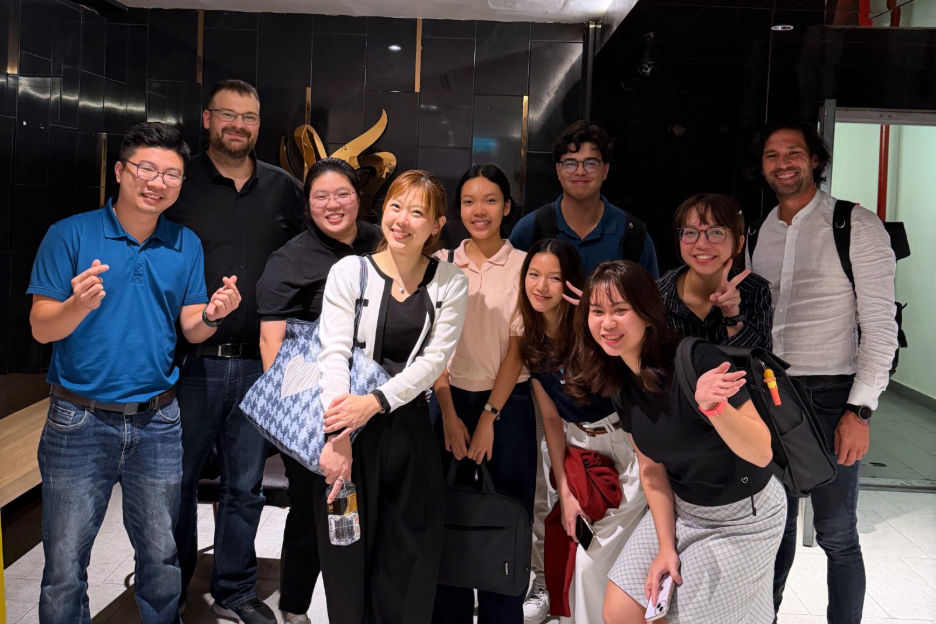
That sense of trust has allowed Pui to manage both roles in a more sustainable way.
Like many working mothers, she still experiences stress. Her approach is to acknowledge it without letting it consume her.
Her son remains an important source of encouragement, while meaningful work and a supportive team motivate her to keep developing professionally.
For Pui, this experience reinforces a belief she holds strongly: women should not have to choose between motherhood and a career.
At Bluebik, different life experiences can contribute valuable perspectives to a team.
Whether someone is a parent, a career changer, or a professional whose journey looks different from a conventional path, that experience can strengthen the way they understand people, approach problems, and create solutions.
“I believe women do not have to choose only one path,” Pui said.
“We can do both. It depends on each person’s circumstances and what motivates them.”
She encourages women to build their own financial stability and create security that does not depend entirely on another person.
When asked what she would say to other working mothers, she shared:
“I would like to encourage other mothers to take care of their physical and emotional well-being consistently.”
“Find small goals that inspire both your life and work. Whether we have children or not, women can always have new dreams.”
“Those dreams do not need to be enormous. We can break them into smaller steps and move forward step by step.”
A Message for Anyone Who Thinks It May Be Too Late to Change Careers
Pui’s story is about reskilling and recognizing that previous experience does not disappear when a person changes careers.
Every role can contribute something valuable to the next one.
Her years as a flight attendant taught her to understand an entire operation while remaining attentive to the individual people within it.
Cabin service focuses on passenger satisfaction, just as technology projects must consider the needs and experience of end users.
Aviation safety requires logical thinking, attention to detail, and the ability to prevent problems while considering how procedures affect people.
These same capabilities are relevant to system analysis.
Her experience as a content creator taught her how to understand requirements, interpret audience needs, select the right way to communicate, and deliver work that fits a specific context.
In practical terms, these are also important parts of a System Analyst’s work.
None of Pui’s previous roles were disconnected from her career today.
Together, they became the foundation that prepared her for a role she had not originally imagined.
At Bluebik, we believe that a person’s potential should not be defined solely by age, educational background, previous job titles, or whether their career path follows a conventional pattern.
What matters is willingness to learn, ability to adapt, and determination to take action.
Pui’s story is therefore not only about an individual decision to reskill.
It reflects what becomes possible when an organization recognizes transferable capabilities, creates room for people to develop, and supports them as they grow into new responsibilities.
When people are given the opportunity to grow, they can bring new perspectives and create greater value for the teams and clients around them.
“I believe our careers do not have to follow a straight line,” Pui said.
“A career path is a journey. Sometimes we travel across land and water. Sometimes we change boats, and sometimes we continue on foot.”
“But if we see every part of the journey as an opportunity to learn and discover more about what we are capable of, we will always find something that encourages us to keep moving forward.”
“It is like traveling to new places and collecting experiences along the way.”
For anyone who has reached the end of Pui’s story and feels ready to explore a new possibility in an organization that values learning, adaptability, and potential, discover current opportunities at Bluebik and apply at: https://bluebik.com/th/job/