












In today’s era, change happens rapidly, especially in technology where AI is playing an increasingly significant role in many areas, affecting business operations and competitive capabilities. How should organizations in this era approach their operations? How should long-established businesses adapt to cope with change? Or how should newly founded businesses lay a foundation to grow strong and sustainably?
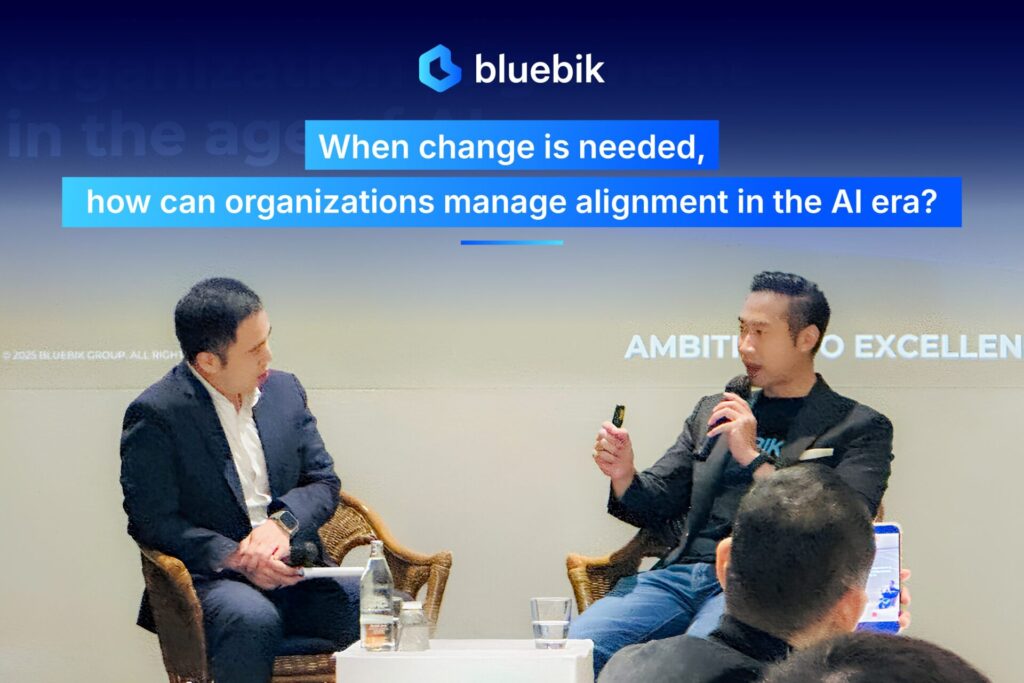
In The Big Blue Ocean training program, Round 4, Pochara Arayakarnkul, CEO of Bluebik Group, had the opportunity to speak on the topic “Change Management and Organization Alignment in the Age of AI,” covering how to cope with change and align the entire organization to work in the same direction in the AI era. Business owners and brand heirs from various industries attended to elevate their organizations to keep pace with the AI era and technology that advances every day. Here is a summary of Pochara’s recommendations:
M&A To-Do-Lists and Change Management
If your organization is undergoing change from merging with another company, how should executives restructure the organization and manage employees from various companies to work together smoothly?
Pochara explained that the foundation of organizational management is people management. Focus on three major areas:
- Communication
Leaders must communicate so that people in the company understand the work/what the company will do and share the same goals. Otherwise, resistance may occur because employees don’t understand how what they’re doing will benefit the company.
The strategy is Overcommunication, or speaking three times more thoroughly, no matter what topic. For example, during the company’s merger, the company creates guides about lunch or transportation to avoid confusing new employees (from the recently merged company) and to make them feel as comfortable as possible.
The Overcommunication strategy can be used for everything, even with clients. We must communicate clearly how the work we’re doing will create change for them.
- Align Incentive, or making employees feel that they also benefit
Pochara explained that when humans resist something, they resist because they feel they don’t benefit. For example, if the company implements AI, some employees might think AI is coming to take their jobs. This is Misalignment Incentive—feeling that the company’s interests don’t align with their own. Therefore, the company must think about how to make employees feel they also benefit, such as activities that show them AI will make their work easier, or setting employee KPIs that tie to organizational success. For example, if working with AI on this task reduces work time by 20%, they can use that reduced work time as leave days, etc.
Another incentive that works is making employees stakeholders in the company. For example, in cases where organizations have quite a few subsidiaries, they might try allowing Management-level employees to hold shares. If those subsidiaries do well, employees will be happy. Another is Variable Pay, or compensation that varies according to work performance. This helps create excitement for employees.
- Reduce the Gap of Capability and Capacity—fulfill employee capabilities and facilitate resources for their work
When companies undergo changes such as mergers or implement new tools, most people struggle because they lack the ability or knowledge to use those tools, or sometimes lack resources to access those tools. This is something the company must facilitate.
When such changes occur, what should be done is Upskill-Reskill programs to train employees with continuous follow-up. If employees still need additional skills, the company can provide them. Moreover, check whether they have sufficient resources. If employees want to learn to use new tools but their workload is still full with no time left to train, the company may need to reprioritize their work or delegate their tasks to other employees. Or if you want them to learn new software but employees don’t have tools to access it, the company should provide them.
Additionally, other factors must be considered:
- Organizational culture—when companies restructure in ways that affect the entire company, it’s not easy. The solution is to use a lot of communication effort.
- Employee qualifications—if you provide Incentives but employees lack skills, motivation, and know they can’t do it, they won’t adapt anyway. Executives must be decisive, ensuring capable people get Incentives.
- Non-financial compensation, such as making employees feel heard and accepted. The clearest example is younger generations, whom many long-established companies often feel they can’t manage—there’s a wall. One method is conducting Focus Groups to try to understand their nature, which reveals many interesting things. For example, Gen Z doesn’t really like Facebook and doesn’t read long text. Therefore, if organizations want to communicate with them, they may need to stop communicating through long emails and instead make short clips, or motivate them to want to join upskilling programs by distributing Badges or special emblems to collect.
Alignment in the Age of AI
Beyond people management, what’s important for organizations in the AI era is improving work efficiency and thinking about how to work better.
Today, AI is changing many work processes, both front-end and back-end, whether it’s customer service, sales, marketing, data analysis to help decision-making, to accounting, admin, Governance work, and Risk Management to minimize costs and constantly compare with previous years’ costs.
Technology is constantly developing, and if used correctly, it can help companies save costs and help make better decisions and planning.
The next interesting question is: Is AI Transformation different from Digital Transformation? Pochara answered that they are part of each other. AI is part of Digital Transformation.
If any organization wants to do AI Transformation or implement AI to help with work, they may need to ask themselves first: Can the current work structure actually do it? Do you have ready data? Do you have a good security system? Simply put, do you have the infrastructure for AI to work well?
Because AI works well depending on data and training it to be better. Organizations with already strong technological foundations will be able to work well with AI.
So if organizations want to implement AI, where should they start first? The answer is: start by analyzing the organization’s work model first—how ready are you to work with AI, and what do you want AI to help with? Pochara divides organizations into 4 major groups:
- The first group is organizations that use AI as assistants for general work, such as buying ChatGPT or Copilot to help with finding information, writing captions, etc.
- The second group is organizations that use AI to help think and analyze, find customer insights, help summarize data, help create models to predict what will happen. This step requires feeding organizational data in, and it must be data stored in a usable format. Therefore, organizations must have reasonably good data storage.
- The third group is organizations that use AI for automation work that runs automatically, which helps reduce human labor in some processes, such as helping with certain finance work that requires recording purchases and sales, where companies need clear workflows.
- The fourth group is organizations that use AI at an advanced level—using AI to help with core services and improve customer experience. For example, digital businesses and banks where customers previously had to walk into banks to make transactions but can now do it through apps.
Pochara also emphasized that AI is just the tip of the iceberg. There are many other factors organizations should consider when implementing AI. Some organizations that implement AI might find their business disappears or must change business models.
Another important matter is processes. AI is just one tool. If implemented, organizations must adjust some processes to align in the same direction. For example, organizations might never have analyzed customer data before. When they have AI, organizations begin to see more customer insights and persuade customers better. Even so, organizations must consider how to improve work processes further. For example, before persuading any customer, there may need to be a customer selection process beforehand to increase sales opportunities for products or services to customers.
Another aspect organizations may need to adjust, which may increase workload, is training AI. Especially in businesses that use AI to analyze and help make decisions. For example, if we have AI help with marketing by recommending influencers, who’s popular today and who’s popular next year may be different people. Therefore, organizations must constantly train models and care for AI like caring for people.
Finally, what must be adjusted is people. Because when AI is implemented, some jobs may disappear (which doesn’t just happen in the AI era but has happened all along, such as document copier positions). What companies must do is train those people to continue working with AI. For example, Content Writers today might use AI to write, and writers move up to become editors to review contents. Or Software Engineers who no longer need to write code themselves, but code from AI still relies on their knowledge and ability to make corrections.
At the end of the session, the moderator asked Pochara: If you want to change the organization, have a plan ready, but when you implement it and the team doesn’t move along, what tips can help you continue?
Pochara recommended returning to look at the three things previously recommended: First—communication, because change will only happen when employees understand each other, and communication is important. The best way to communicate, besides communicating thoroughly, is to lead by example. Leaders must use AI extensively enough before telling subordinates to use it. Second—create motivation or Incentives to reduce resistance. And third—facilitate employees regarding work tools and increase their skills and capabilities.