












AI-Powered Cybersecurity: Securing the Enterprise When AI Is Both Value Creator and Vulnerability
As AI creates both upside and downside risk, organizations must strengthen their cyber resilience with a modern, proactive framework—one capable of defending against threats that now evolve, scale, and strike at AI speed.

We are entering an era where AI is embedded across every core business process, expanding both operational capabilities and the surfaces attackers can exploit. Cyber threats can now penetrate deeply into data, AI models, and the AI supply chain—with impacts that are more severe and far faster-scaling than in the past. This shift is pushing organizations to modernize their security capabilities—from data and governance to recovery—to withstand AI-driven attacks that are more complex, faster, and exponentially scalable.
This shift is redefining the enterprise risk landscape, expanding exposure far beyond traditional IT boundaries. What was once contained within isolated systems now cascades across the entire enterprise ecosystem. AI-enabled attacks are increasingly precise and massively scalable, making it essential for organizations—and people—to understand the emerging wave of cyber risks. These are the Cyber Risk Trends now defining security in an AI-led landscape.
Cyber Risk Trends: A More Complex Threat Landscape in an AI-Led World
As AI reshapes the enterprise, organizations can no longer rely on traditional frameworks or legacy standards to assess their cyber maturity. Several powerful forces are now pushing leaders to reimagine and rebuild their security model from the ground up.
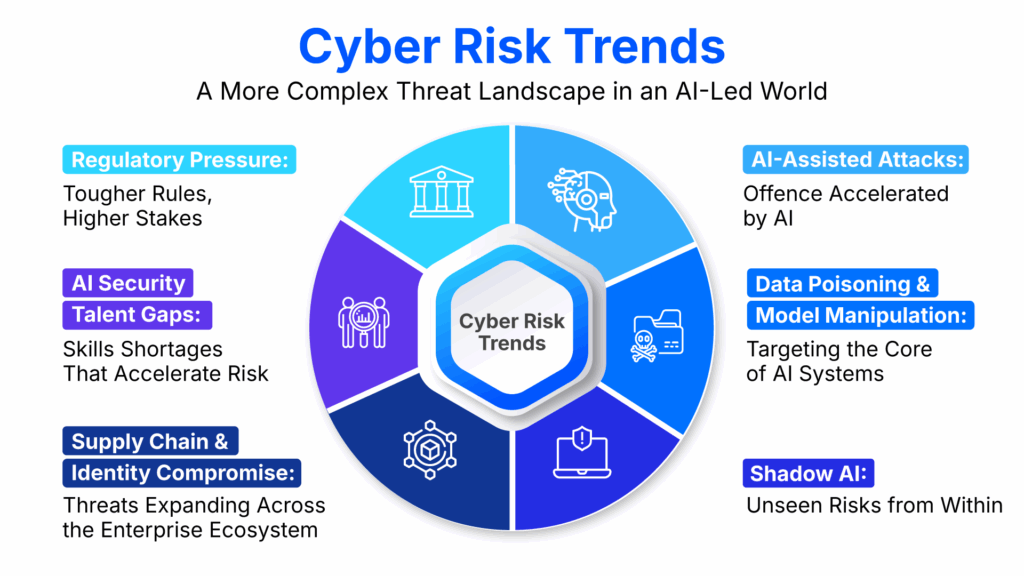
1. Regulatory Pressure: Tougher Rules, Higher Stakes
Governments worldwide are enforcing stricter requirements on AI governance, transparency, and accountability. Organizations that fail to adapt will face rising operational, financial, and reputational risks.
2. AI Security Talent Gaps: Skills Shortages That Accelerate Risk
Most existing cybersecurity teams lack the specialized capabilities required to secure AI systems—ranging from protecting AI pipelines and monitoring model behavior to detecting adversarial attacks. This gap is widening quickly: organizations cannot build or hire AI-security talent fast enough to match the pace at which AI-driven risks are expanding.
3. Supply Chain & Identity Compromise: Threats Expanding Across the Enterprise Ecosystem
Supply-chain attacks and identity compromise remain primary attack vectors—but AI is making them far more damaging. AI now enables adversaries to mimic human behavior with high precision and generates convincing fake identities, making these attacks increasingly difficult to detect and significantly more impactful across the enterprise ecosystem.
4. AI-Assisted Attacks: Offence Accelerated by AI
Cybercriminals are now weaponizing Generative AI to accelerate and amplify their attacks—making them faster, more sophisticated, and significantly harder to detect. AI enables adversaries to automate highly convincing phishing campaigns, rapidly evolve malware, and generate realistic deepfakes that support seamless social engineering. What once required time, expertise, and manual effort can now be executed instantly and at a scale, dramatically increasing both the reach and impact of a single attack.
5. Data Poisoning & Model Manipulation: Targeting the Core of AI Systems
Attackers are increasingly focusing on corrupting training data or compromising the model inference process—causing models to make incorrect decisions or reveal sensitive information. Even subtle manipulations can distort model behavior in ways that are difficult to detect, creating risks that extend deep into the AI lifecycle.
6. Shadow AI: Unseen Risks from Within
Across many organizations, AI tools are being adopted without awareness of the new dependencies and hidden exposures they introduce. Unvetted API connections, unmanaged data flows, and unsanctioned AI usage create security vulnerabilities that often go unnoticed expanding the attack surface beyond the organization’s formal governance and controls.
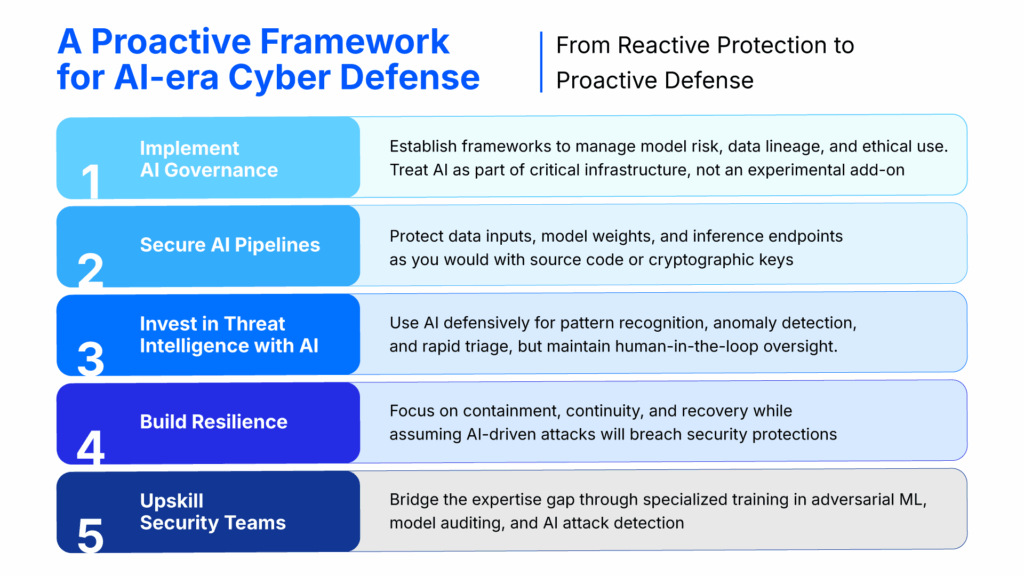
A Proactive Framework for AI-Era Cyber Defense: From Reactive Protection to Proactive Defense
The speed and sophistication of AI-enabled attacks now exceed the response capacity of traditional security models. Organizations can no longer afford to wait for incidents before responding. AI-driven threats can mimic human behavior, corrupt training data, compromise AI models, or infiltrate the supply chain—often within seconds—making reactive security fundamentally insufficient.
Three Strategic Pillars of AI-Powered Cyber Defense
Effective cyber defense in the AI era depends on an organization’s ability to elevate and integrate three core dimensions—People, Process, and Technology—in a balanced and coherent way. These pillars form the foundation for continuous, resilient, and sustainable protection.
1. People — Human Judgment as the Last Line of Defense
No matter how advanced the technology becomes, human judgment remains the final safeguard in AI-era cybersecurity. People act as decision-makers and controllers at critical points, ensuring that security measures function as intended.
Gaps in AI-security knowledge have now become systemic risks, limiting an organization’s ability to assess, control, and respond to emerging threats.
Key Actions
- Deliver targeted AI-security upskilling for cyber and risk teams
- Establish specialized units such as an AI Security Taskforce
- Embed a Security-by-Design culture across teams and projects
2. Process — Governance Is the New Perimeter
AI-driven cyber threats are elevating governance as the defining perimeter of modern security.
Organizations must identify and assess AI-related risks across the full lifecycle—data preparation, model development, deployment, monitoring, and incident response.
Governance must be clear, auditable, and consistently applied across the enterprise.
Cyber resilience also requires adopting an assume-breach mindset, supported by strong business-continuity plans and rapid recovery processes to minimize impact.
Key Actions
- Develop an AI Governance Framework integrating data, models, and operations
- Create and regularly test Response & Recovery playbooks
- Embed AI-risk assessment into every phase of the model lifecycle
3. Technology — Defense at Machine Speed
In today’s landscape, AI acts as both a sword and a shield. Organizations must evolve their cyber capabilities to operate at machine speed, where AI-enabled attacks can escalate faster than manual defenses can respond. Modern architectures require both:
- Defensive AI to detect anomalies rapidly and accurately
- Proactive/offensive testing to identify weaknesses before attackers exploit them
Key Actions
- Invest in cybersecurity platforms enabling automated detection and response
- Integrate automation, advanced analytics, and human-in-the-loop oversight
- Conduct continuous proactive testing—Red Teaming, Model Stress Testing, and other adversarial simulations
Securing the Enterprise at AI Speed
We are entering a world where AI is both a catalyst for business growth and a profound source of cyber risk. In this environment, the most prepared organizations are not those with the most advanced technology, but those that recognize their risks earlier, adapt faster, and orchestrate People, Process, and Technology in a cohesive, strategic way.
This new standard of AI-era cybersecurity spans the full spectrum of defense—prevention, detection, response, containment, continuity, and rapid recovery—to preserve trust and sustain operational resilience.
In a landscape where everything moves at AI speed, resilience belongs to organizations that can wield AI as both shield and sword, transforming cybersecurity from a defensive cost center into a strategic enabler of trusted, sustainable growth.