












How Far Can an IT PM Grow?
A Conversation with “Fon” Associate Director, Program Management at Bluebik
What does an IT Project Manager actually do? How is this role different from a general Project Manager? Most importantly, how does becoming an IT PM contribute to long-term career growth?

To answer these questions, we asked Fon, Associate Director, Program Management in our Digital Excellence and Delivery (DX) team, to share her story. With her experience leading complex projects and mentoring junior IT PMs, Fon gives us an inside look at how standards, delivery, and growth come together at Bluebik.
Before joining Bluebik, Fon held leadership roles, including BA Lead and Test Lead, focusing on specific parts of the software development process. Over time, she became curious about how all the pieces fit together and wanted to see the whole picture. This curiosity led her to become an IT Project Manager at Bluebik, where she now manages IT projects from start to finish for a range of organizations and industries.
This change meant moving from a narrow area of expertise to a broader, end-to-end view that requires clear thinking and attention to detail. Although the transition was challenging, it helped Fon grow both personally and professionally.
In this article, Fon shares five key areas of growth she has experienced as an IT PM. But first, let’s take a closer look at what the IT PM role entails and how working at Bluebik supports that growth.
The IT Project Manager: The Central Hub of Communication from Start to Finish
In many ways, the IT PM shares similarities with Project Managers. The key difference lies in the nature of IT projects, which require a deeper technical understanding and constant coordination across diverse teams, often spanning functions, countries, and time zones.
An IT PM works closely with everyone involved in the delivery process, including Business Analysts (BA) and System Analysts (SA), Developers, Infrastructure teams, and QA.
At the core of the role is acting as the project’s Single Source of Truth, the central point of communication and decision-making. This includes setting direction, planning activities across teams, aligning priorities, managing risks, and resolving issues. All project-critical information converges at the IT PM.
Fon explains:
“Our role is to manage and resolve issues that arise day to day. When a team encounters a problem, we need to understand what it is, how critical it is, and whether it can wait or requires immediate action. If the issue is critical, we also need to decide how to manage it and whether a war room is necessary. All of these decisions fall under the responsibility of the IT PM.”
When making decisions, Fon relies on two key dimensions: impact and likelihood of risk.
“Every project has its roadmap and product priorities. We know which components are critical; for example, the core features of an application. If those are blocked, the product can’t move forward, which makes it a critical issue with direct business impact. If it also affects the timeline, the risk becomes even higher and requires urgent action. On the other hand, if the business impact hasn’t materialized yet because we’re still ahead of the timeline, the issue may be monitored first. That’s why we always assess both dimensions together.”
What Makes a Good Manager at Bluebik: From Challenge to Mastery
Challenging work often accelerates growth. For Fon, one of the most demanding experiences in her career was managing a large-scale project involving nearly 100 team members, a substantial budget, and high public visibility.
The project had a tight deadline, and the direction, priorities, and requirements often changed quickly. It was a high-pressure situation, but it helped Fon and her team grow and improve their skills.
“The first thing we had to do was prioritize work across teams and manage issues in a way that allowed everyone to stay focused. In many cases, the IT PM acts as the first line of defense, absorbing complexity so the team can perform at their best and deliver quality work, even under pressure.”
“We also had to constantly assess risks, both those within our control and those outside it. If we don’t take action A, B, or C, what could go wrong? And if those actions aren’t possible, are there alternative approaches that can reduce the intensity of the risk?”
The project was successfully delivered in about four months. Although it was the most challenging project Fon has worked on, she sees it as a time of exponential learning for herself and the entire team.
“An IT PM needs to create an environment where the team feels safe to experiment and learn. Mistakes are okay; we try again. We don’t blame each other. That’s part of the learning process. Throughout the project, everyone understands that we’re working toward meaningful change.”
Fon also believes that success is never achieved by just one person.
“The PM is only one part of the equation. What truly matters is that the team moves forward together with a shared growth mindset. Even if the PM helps drive or coordinate the work, success belongs to everyone, and everyone deserves credit.”
Growth Environment at Bluebik: A Place for Ongoing Development
While Fon consistently encourages a growth mindset within her teams, she has also continued to grow herself, supported by Bluebik’s growth-oriented environment. She highlights several factors that have made a meaningful difference.
The first is decision-making autonomy and trust.
“At Bluebik, we have a high degree of autonomy. There’s no rigid rule that says you must use only one methodology. We’re encouraged to experiment and learn. If we adapt our approach and it results in a smarter or more effective outcome, we can openly discuss it, apply it to our projects, and even share those learnings with other teams.”
Another key factor is the culture of knowledge sharing.
“If a project feels stuck, we can reach out to other teams for lessons learned or advice. That’s something quite different from other environments. We have mentors and colleagues across projects who are always willing to help, whether they’re PMs or specialists in other domains. Knowledge sharing is always encouraged, both within and beyond the scope of our own projects.”
Bluebik also gives IT PMs the opportunity to work on a wide range of projects with diverse clients and industries. The company also encourages trying new tools and technologies to boost productivity. Nowadays, the projects often involve teams from multiple countries. English communication skills also naturally become part of the IT PM’s professional growth.
All these factors have helped Fon grow, so we asked her to share the five areas of growth she is most proud of.
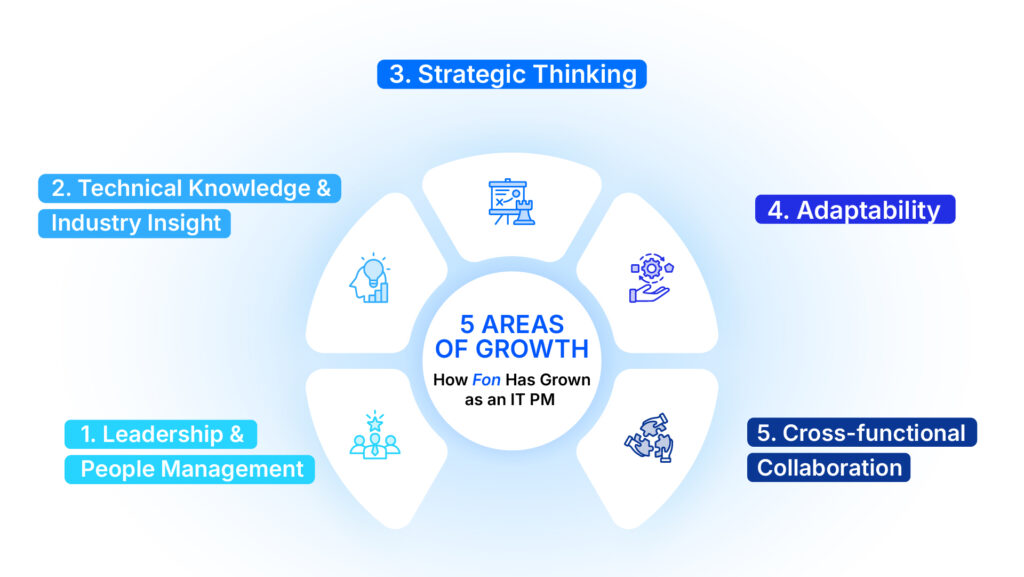
5 Areas of Growth: How Fon Has Grown as an IT PM
1. Leadership and People Management
“I’ve shifted from focusing solely on my own responsibilities to inspiring others. I’ve grown significantly in communication, team facilitation, and handling difficult or conflict-driven conversations.”
2. Technical Knowledge and Industry Insight
“Working across diverse industries has expanded my perspective, from digital transformation initiatives to executive-level vision. Along the way, I’ve gained exposure to modern tools and technologies, and I’m constantly aware of how fast the world is moving.”
3. Strategic Thinking
“I’ve learned to consider long-term impact and connect project work to our clients’ business goals. Our work doesn’t end at delivery; we continue the journey with our clients, understanding their evolving objectives and working together to achieve them.”
4. Adaptability
“IT PMs face real-time challenges every day, internally, externally, and sometimes from third-party stakeholders. We need to adapt quickly, accept change and mistakes, and manage situations so that everyone can move forward together.”
5. Cross-functional Collaboration
“I’ve worked with people across business, technology, marketing, and customer teams. I’ve learned from experts both inside and outside the organization, in Thailand and internationally.”
These five areas have made Fon more confident and secure in her career. She also hopes that future IT PMs can learn from her experiences and those of her teams, passing on a positive attitude to the next generation.
This kind of growth defines the IT PM role at Bluebik, and we invite you to learn more.
Interested in an IT PM Role at Bluebik?
- Project Management Consultant (IT Project Manager) – Entry Level https://bluebik.com/th/job/project-management-consultant/
- Senior Project Management Consultant (IT Project Manager) – Experienced Hire https://bluebik.com/th/job/lead-project-management-consultant-project-manager/