













A Data Scientist typically works with various data types to generate insights that drive business decisions. At Bluebik, the bar is higher. Here, being a Data Scientist means not just analyzing and presenting data but transforming it into tangible business outcomes.
Tide, a Senior Data Scientist on Bluebik’s Advanced Insights team, is known for delivering high-impact, quality work. What makes him stand out is his focus on growth. Over his career, he has developed by seeking feedback, taking full ownership of problems, staying curious beyond technical tasks, and focusing on real business results instead of just technical wins. With his consulting experience, he highlights five key areas that show how much a Data Scientist can grow with the right challenges.
His journey began with a genuine interest in using information to explain customer behavior and support decision-making. Along the way, he realized he did not want to limit himself to summary reports. He wanted to go deeper, exploring what questions data could answer, where it could drive prediction, and where it could unlock efficiency. That curiosity pushed him to connect the dots between data, technology, and business, creating real value for organizations. At Bluebik, he has worked across a wide range of industries, including banking, automotive, and energy.
We asked Tide what makes his role unique.
Data Scientist: From Data Analyst to Business Problem Solver
“The role of a Data Scientist isn’t just about building models,” Tide explains.
“It covers everything from understanding the business problem and asking the right questions, to exploring and assessing data quality, designing features, building the right logic, developing and evaluating models, and ultimately communicating insights in a way that the business team can actually act on.”
“In the context of Bluebik as a leading Digital Enterprise Transformation consulting firm, the scope expands even broader. We’re not here to build models that look impressive on a screen. We’re here to help clients get clarity on the actual problem they’re trying to solve.”
“A Data Scientist is not just one type of craftsman. We translate the homeowner’s needs into something that can actually be built and lived in. If I had to simplify it, it is like being both an architect and an engineer at the same time.”
To explain further, an architect needs to know what kind of home the owner wants, how they plan to use it, the budget, and any limits. In data work, this means understanding the business problem, what stakeholders expect, and what success looks like. A structural engineer checks the site, making sure the foundation is solid, there are enough materials, and all systems connect properly. In data, this means checking data quality, designing features, choosing the right model, and setting up effective data governance.
3 Levels of Data Utilization: Turning Data into Real Change
“No matter what the data is, it only makes a difference if you turn it into something the organization can use to make decisions,” Tide says. He sees three main ways data can drive real change:
1. Descriptive & Diagnostic: This means using data to help a company see what happened and why. For example, it could show where customer behavior changed, which groups are most at risk, or if a past campaign met its goals.
2. Predictive: Using data to forecast what might happen next. This includes things like churn prediction, demand forecasting, and customer value scoring. These help organizations look back at what happened and plan for what’s ahead.
3. Action Driven: This is the most important level. Data should lead to action. For example, it can help identify target groups, design custom campaigns, and determine how to retain customers and boost profits.
“In consulting, our role is not just to highlight interesting insights. We must help clients answer what to do next and how to measure success. That is where data truly drives change.” Tide Added.
4 Principles of High Performance: What It Takes to Be a Great Data Scientist
To succeed as a Data Scientist at Bluebik, Tide highlights four key skills:
1. Technical Foundation: Solid fundamentals across statistics, data preparation, machine learning, feature engineering, and model evaluation. Equally important is knowing the limitations of each approach: when to use a method, when not to, and why.
2. Business Understanding: The ability to identify the real business problem, understand key success metrics, and deliver outputs that are usable in real-world contexts.
3. Communication and Stakeholder Management: The ability to create alignment across different audiences, so everyone is working from the same picture.
4. Execution Mindset: Getting ideas all the way to implementation. That means thinking through deployment, driving adoption, maintaining monitoring, and ensuring the solution is sustainable over time.
5 Areas of Growth: From Data Scientist to Trusted Advisor
When asked about the growth environment at Bluebik, Tide shared:
“The organization supports not only resources and learning, but also the level of work and expectations. We work on diverse and highly challenging problems, which forces us to continuously rethink our approach. You cannot rely on the same method for every problem.”
“More importantly, we are not limited to a small part of the process. We get to work end-to-end. This allows us to fully demonstrate our capabilities across technical, business, and consulting dimensions. What I appreciate most is the culture of giving people opportunities to take on bigger responsibilities as they grow.”
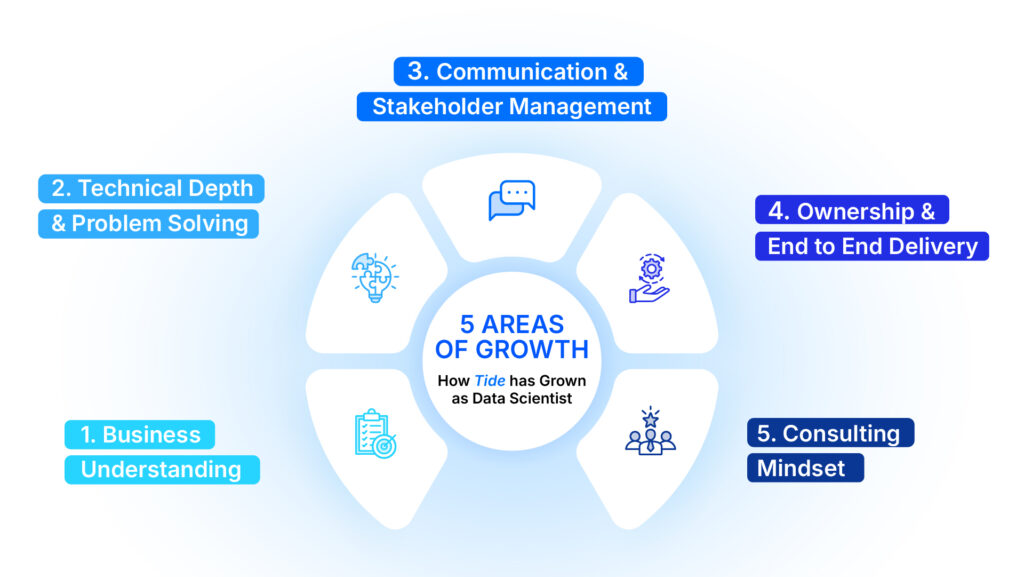
In this environment, Tide highlights five main areas for growth:
1. Business Understanding
“This is probably where I have grown the most. My understanding of business has become significantly deeper. Earlier in my career, I was focused on finding answers in the data or on improving model performance to strong numbers. Coming to Bluebik, I learned what actually matters first: the business problem, the decision the organization is trying to make, and the outcome that would matter to the stakeholders. The shift that’s most obvious to me is that I no longer start by asking ‘what model should I use?’ I start by asking, ‘If we solve this problem, what is the impact?’ That reframe has made my entire way of thinking more professional.”
2. Technical Depth and Problem Solving
“Working across diverse problems, each with its own data limitations, has pushed me beyond just model building. I’ve had to develop the ability to design the right approach for the problem at hand, choosing methods that balance accuracy, interpretability, and real-world readiness. I don’t think about technical skills as isolated competencies anymore. I see them as a system: how do data, execution, evaluation, and business constraints connect to produce the best possible solution?”
3. Communication and Stakeholder Management
“Since joining Bluebik, I’ve had consistent practice explaining complex things clearly to very different audiences: senior executives, business teams, and technical teams. That also means managing expectations, building shared understanding among multiple stakeholders, and driving alignment and clear direction. The biggest shift I notice in myself is that I used to focus on getting the answer right. Now I focus equally on making sure the right people hear it in the right way.”
4. Ownership and End-to-End Delivery
“At Bluebik, I’ve come to understand that a Data Scientist who creates real impact has to see the full picture. That means owning the work from problem framing through to recommendations and real-world implementation. I’ve shifted from someone who focused on doing their part well, to someone who thinks about how the whole thing succeeds: what are the risks, what drives it forward, and how do we make sure it actually lands?”
5. Consulting Mindset
“One of the biggest shifts for me has been thinking in terms of client value. I’ve learned that the best answer isn’t always the most complex or technically advanced. It’s the one that fits the client’s context and actually produces results. That change in perspective is what has made me feel like I’m growing from being a Data Scientist into being a Trusted Advisor.”
The 6 Checklists of Excellence: The Personal Standards That Define Great Work
When asked what excellence means, Tide shared his personal checklist.
1. The problem is clear: The problem must be well defined. I always ask what the goal is and how to measure success. Without clarity, even the best model might not be useful.
2. Data is trustworthy: The data must be reliable. I check data quality every time, looking at completeness, consistency, and assumptions. For me, the work can’t be excellent if we’re not sure about the data quality.
3. Method is appropriate: Picking the right method isn’t just about complexity or accuracy. It’s about what fits the purpose. Sometimes, a model that’s too complex and hard to explain isn’t the best choice. I focus on tools that truly solve the business need, not just the technical one.
4. Output must be accurate and complete: Deliverables need to be both correct and thorough. It’s not just about showing numbers or insights alone. It means checking everything carefully, being open with clients about data limits, and making sure quality checks are done before sharing results.
5. Insights lead to action: My work should always lead to action. I ask myself, after seeing these results, what can stakeholders actually do next? If the answer is just ‘read the report,’ there’s still room to improve. That question keeps my work honest.
6. Reusability and Sustainability: Solutions must be sustainable. That means writing clean, standards-compliant code, avoiding brittle logic that is hard to adapt, and making sure the solution is reproducible and monitorable. The goal is always for the client’s team to be able to pick it up, maintain it, and build on it effectively, long after the engagement ends.