













Maximizing Strategic Resilience and Operational Excellence Through Unified AI Architecture.

The momentum of AI Transformation has reached a tipping point, placing a critical mandate on organizations to embed artificial intelligence into their backbone operations. The objective is to modernize workflows and sharpen the competitive edge. However, early AI adoption typically occurred in isolation, reflecting a nascent stage where the eventual necessity for cross-functional orchestration was not yet anticipated. Consequently, many organizations now face a “Scalability Plateau”—a state of ‘Siloed AI’ where isolated functions create process friction and data inconsistencies that fundamentally erode the fidelity of business outcomes.
Thailand’s AI-Driven Leadership Report 2026—a collaborative strategic study by Bluebik, The Standard, and Sauce Skills—reveals that while 97% of surveyed enterprises have initiated AI projects, the majority remain encumbered by structural silos. This systemic fragmentation prevents organizations from achieving true AI Maturity. The resulting ‘Execution Gap’ acts as a significant bottleneck, stifling the ability to scale AI and unlock measurable Business Value at Scale.
The Strategic Gap: The Perils of Ad-hoc AI Development
Organizations often find themselves in a precarious position due to “Ad-hoc Development”—the rapid, decentralized deployment of AI models without a cohesive Architectural Blueprint. When initial growth occurs without anticipating future integration needs, it inevitably leads to systemic risks and suboptimal resource allocation:
- Unmanageable Complexity: Fragmented systems create an overwhelming maintenance burden, accumulating “Technical Debt” that paralyzes long-term organizational agility.
- The Reliability Gap: A lack of professional tuning and rigorous governance over advanced models often leads to AI Hallucinations, compromising decision-making fidelity and damaging brand equity.
- Strategic Misalignment: A narrow focus on technical “quick wins” rather than integrated business outcomes leaves AI initiatives stranded in “PoC Purgatory,” failing to deliver a sustainable ROI.
AI Workflow Orchestration: The Mission-Critical Command Center

Addressing structural failures requires a profound Architectural Transformation. Organizations must pivot toward AI Workflow Orchestration—a “Mission-Critical Command Center” designed to harmonize cognitive assets into a high-velocity, End-to-End Synergy. This framework operates across two vital dimensions:
- Orchestration Logic: Manages complex State Management and governs the seamless exchange of data between AI agents and Legacy Systems, ensuring maximum precision and security.
- Operational Agility: Reduces IT complexity by creating a modular environment, allowing for rapid reconfiguration or upgrading of AI models without disrupting core business functions.
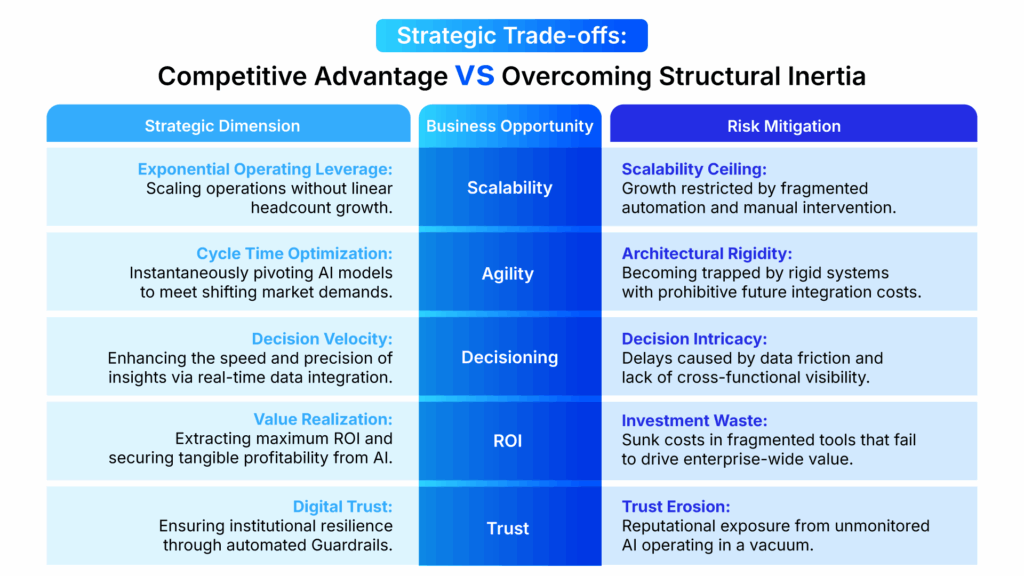
Strategic Trade-offs: Competitive Advantage vs. Overcoming Structural Inertia
Adopting an orchestrated architecture is a strategic pivot. It represents the choice between securing Sustainable Market Leadership or remaining tethered to Structural Inertia—an inherent operational rigidity that will only intensify as technology evolves.
The Vanguard of Orchestration: Benchmarking Global Success
Leading global enterprises have already moved beyond isolated experimentation, re-architecting their operational foundations for systemic impact and long-term value:
- Banking (DBS Bank): Generated SGD 1 billion in business value in 2025 by shifting to an AI Industrialization strategy. By leveraging a centralized orchestration platform, they compressed AI deployment cycles from 18 months to just 2–5 months, achieving unprecedented speed-to-market.
- Investment Banking (J.P. Morgan Chase): Their “Ask David” initiative utilizes Multi-Agent Orchestration to transform investment research. A Supervisor Agent coordinates specialized sub-agents to analyze complex data sets, ensuring high-fidelity decision support for multi-billion dollar asset management.
- Retail (Walmart): Operates a real-time AI Orchestration Ecosystem (Walmart Fulfillment Engine). Its “Self-Healing Inventory” system alone has delivered over $55 million in cost savings by seamlessly synchronizing demand forecasting with last-mile logistics.
- Manufacturing (Siemens): Deployed an Industrial AI Orchestration Layer to integrate AI directly into physical manufacturing workflows. This integration of digital intelligence with industrial hardware has realized a 125% increase in productivity and enhanced operational flexibility.
4 Pillars of AI Workflow Orchestration: The Engine of Operational Excellence

To deliver true Operational Excellence, a robust AI Workflow Orchestration framework must be anchored by four critical pillars that define the new global standard for architectural rigor:
- Autonomous Reasoning & Intent-Driven Planning: Orchestration shifts AI from task-based commands to systems that internalize “Business Intent” via Goal Decomposition. By translating high-level strategy into autonomous execution paths, it drastically increases Decision Velocity while reducing the burden of constant manual oversight.
- Multi-Agent Workflow Synchronization: This is the core of orchestration—managing a complex ecosystem of specialized agents through centralized State Management. By ensuring precise, high-fidelity hand-offs between AI and Legacy Infrastructure, organizations achieve significant “Time Reclaimed,” empowering talent to focus on high-value strategic initiatives.
- Contextual Semantic Interoperability: Orchestration ensures that AI understands the “Meaning and Goals” of the business through Semantic Mapping. This unifies disparate data streams into a “Single Source of Truth,” maximizing operational precision and ensuring cognitive alignment across every automated process.
- Embedded Governance & Automated Guardrails: Integrating Security by Design via Policy-as-Code directly into the orchestration layer. This ensures that AI behavior consistently adheres to internal policies and regulatory standards in real-time, fostering long-term Digital Trust and securing institutional resilience.
Implementation Roadmap: The Strategic Path to AI Workflow Orchestration
Achieving orchestration requires a disciplined, phased framework to effectively de-risk the shift from fragmented pilots to synchronized enterprise operations. This roadmap provides a clear, high-velocity path for scaling AI with strategic precision.
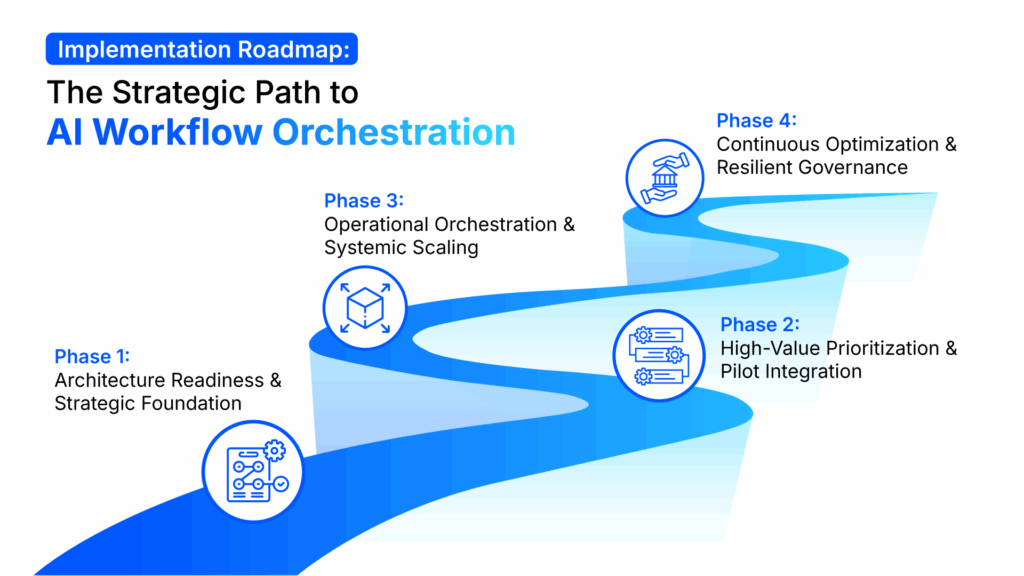
Phase 1: Architecture Readiness & Strategic Foundation – Establishing a clear architectural blueprint by identifying legacy bottlenecks and defining an orchestration vision that is strictly aligned with core business objectives and backbone operations.
Phase 2: High-Value Prioritization & Pilot Integration – Selecting high-impact workflows for targeted pilot projects to demonstrate immediate value realization while standardizing data protocols for eventual enterprise-wide scaling.
Phase 3: Operational Orchestration & Systemic Scaling – Deploying the orchestration layer to harmonize AI agents with backbone operations, while managing the cultural change and human-centric shifts required to foster frictionless human-AI collaboration.
Phase 4: Continuous Optimization & Resilient Governance – Utilizing real-time feedback loops to tune system performance and maintaining automated guardrails to ensure institutional resilience and long-term digital trust.
Conclusion
Ultimately, the definitive competitive edge in the AI-first era lies in an organization’s ability to synchronize its cognitive assets into a single, high-performance ecosystem. This level of maturity demands a deep integration of business strategy and technical execution—a bridge that many struggle to build. Establishing a resilient architectural framework today is a critical strategic pivot to overcome structural inertia and secure sustainable operational excellence. This is the core focus of Bluebik as we partner with leaders to translate the immense potential of AI into measurable, enterprise-wide business value.