












For someone to work at an organization for nearly 20 years means they have found what the organization values, and the organization has also become a place that supports what they value as well.
The two individuals who share their perspectives with us this time exemplify this perfectly. The first has worked at Bluebik Vulcan (starting from when it was still MFEC before becoming part of Bluebik Group) for a full 20 years. The other has worked here for an equally impressive 19 years—and this is her first and only workplace.
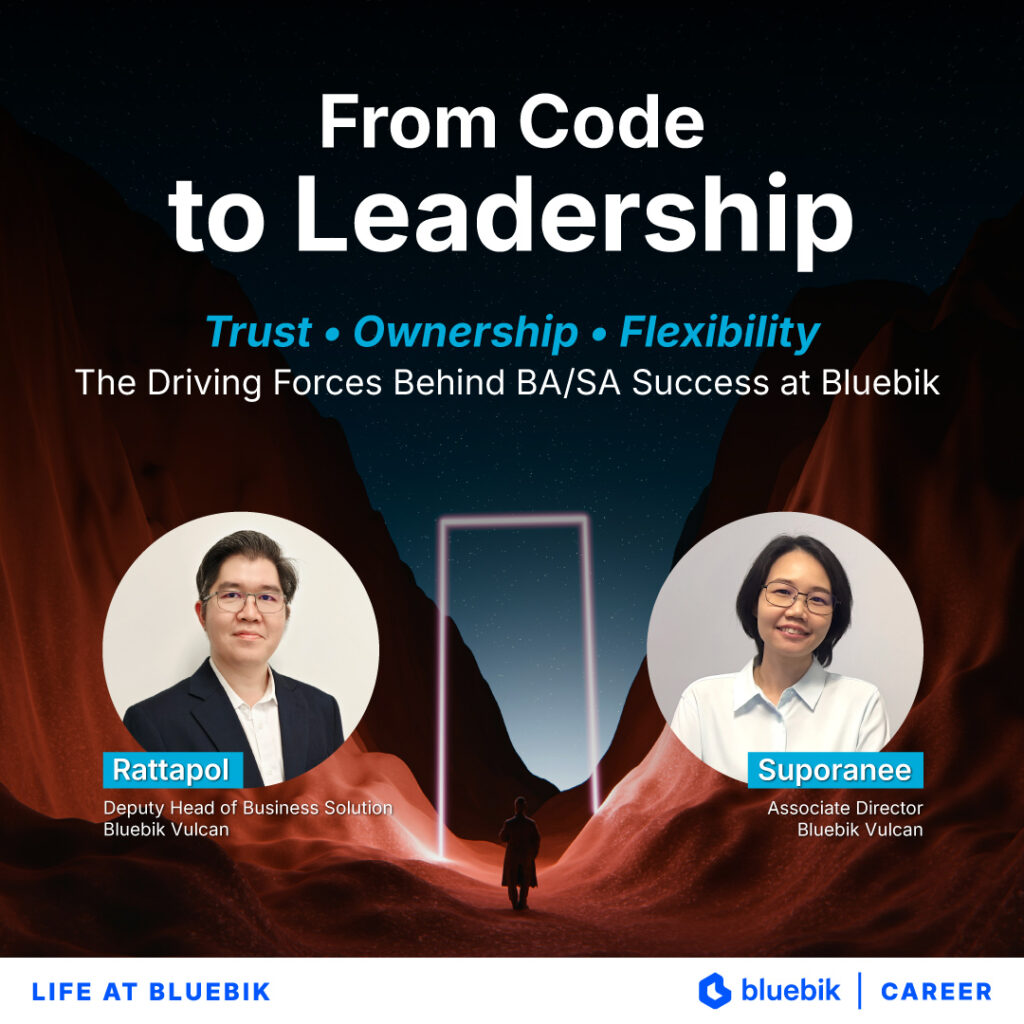
Rattapol (Pom) is the Deputy Head of Business Solution for the Tech Solution Delivery team at Bluebik Vulcan, directly overseeing the Business Analyst and System Analyst (BA/SA) team.
Suporanee (Jae) is a Associate Director for the Tech Solution Delivery team, like Pom, but she supports clients in the capacity of Financial PMO.
Both started their careers as Developers before transitioning into the business track and growing into management roles. Throughout their tenure, they have both gained extensive experience as BA/SA professionals and have worked alongside junior BA/SA team members for many years.
The reason they have stayed with the organization for two decades is essentially the same: the “enjoyment” and “challenge” within every project they undertake. For them, transitioning from a completed project to a new one is like “trying something new” because every project brings a different flavor. The more successful they are with each project, the more they enjoy this path and the more they want to challenge themselves with new endeavors.
This time, we invited Pom and Jae to share their perspectives on the three key factors that lead to BA/SA success—elements they continuously strive to cultivate in their work: Trust, Ownership, and Flexibility. They also discuss creating a Legacy that serves as a way of working that can be passed on to future generations of professionals with pride.
What do these aspects look like in practice? Let’s explore them together.
Trust: Earning Client Confidence by “Buttoning the First Button Right” and Delivering Quality Work
Gaining client trust is one of the most critical factors, and to earn that trust, the team must start at the right point. Pom explains that being a BA/SA requires understanding the “true objective of the project” first and foremost.
“We need to understand first which part of the client’s business the application we’re building is meant to support. For example, is it to increase the customer base, reduce company costs, or increase revenue? We need to thoroughly understand what the real goal is, what the project theme is, and who the primary target audience is. With these principles, we can build the project within the framework the client wants and begin to earn their confidence.”
Naturally, from the client’s perspective, achieving all objectives simultaneously is the ideal scenario. Therefore, Pom believes BA/SA professionals must communicate with clients to help them see priorities— which goals should take precedence, how to sequence them, what is necessary and connected to the company’s core values, and what is merely “nice to have.”
Jae agrees with this point, stating: “Understanding the client’s needs deeply as the ‘first button’ is most critical. If we misinterpret the requirements, the entire project team will lose direction.”
The next priority is quality. Jae defines “quality work” in terms of commitment and Agile methodology, which ensures continuous quality checks.
“First and foremost, whatever we commit to, we must deliver accordingly. Our work must be of good quality with no bugs.”
“We must continuously inspect quality to ensure our output meets standards and client requirements. When integrating other components, we must test to ensure that what we’re adding doesn’t damage previous work. This is regression testing—a process that ensures changes or additions of new code don’t cause other elements to regress.”
This also includes working closely with clients with sincerity. (On the day of our conversation, both Pom and Jae had just returned from an on-site visit at a client’s office, which is a core responsibility for both.)
Jae explains: “As consultants, we believe in providing straightforward advice. We’re not just focused on selling projects; we offer alternatives or adjust processes that may not necessarily require a digital solution, so clients feel they can consult with us long-term.”
Pom adds: “Ultimately, to make clients trust us, when they have issues and pick up the phone to call us, there must always be a response. We must provide service without abandonment.”
Delivering quality work and non-abandoning services naturally comes with many challenges, which Pom believes BA/SA professionals must always find ways to manage. For instance, if client requirements change, we must negotiate and manage expectations to avoid harming the project.
If there are misalignments within the client’s organization, it is the BA/SA’s responsibility to communicate and coordinate to reach a clear mutual agreement. Even when challenges come in the form of old documentation or legacy technology, the team must use “investigative” skills to analyze those documents or code to fully understand the data and systems first.
When these challenges are managed effectively, quality and client trust naturally follow.
Ownership: A Mindset That Drives Teams to Perform at Full Capacity
What motivates people to devote their energy to work more than feeling ownership of that work? On this point, Jae shares:
“Working with the mindset that the output is ‘your own’ or is ‘your child’ leads to design and development that is attentive to quality.”
She encourages the team to view things from the user’s perspective:
“When designing something, try to see if you were the user yourself—if we built it this way, would you want to use it? Or would we be confident enough to tell others this is what we built? If we’re confident enough to say that, it means we have ownership.”
Moreover, involving everyone in the work, regardless of their level, helps build shared ownership.
“At Bluebik Vulcan, we give people at every level the opportunity to take responsibility because everyone’s opinions are valuable. The level of risk they manage may differ, but participation is important.”
Pom shares a similar sentiment: “I always tell my junior colleagues that one of our key themes is ownership. Whatever we do, we must view ourselves as the user and see that work as our own. This influences our mindset positively because it makes us think ahead for the client and consider innovation.”
He adds: “If we build a mobile banking app and see someone using it on the train, it’s incredibly fulfilling because we feel this is our work. That’s ownership. Once that feeling happens, it carries forward—into every new project.”
Just as Jae mentioned, Pom also encourages the team to think from the user’s perspective:
“It’s about considering how we would use it if we were them. And if the app is internal for a client organization, we must help the team understand how important it is to the client’s employees. When we highlight the impact, ownership will follow naturally.”
Flexibility: Time and Method Flexibility That Comes With Proper Balance
Saying that both Pom and Jae are leaders who provide flexibility to their teams almost constantly would not be an exaggeration. Flexibility leads to better working methods, timing, and performance—but it must be balanced with discipline to avoid compromising accountability.
Regarding working methods, Pom explains that he never limits which tools people can use, but there must be standards and templates to ensure consistency:
“Everything can be adjusted. If you find a tool that doesn’t serve you well, you can return to what we’ve prepared. But at minimum, understand why the template exists—it’s there so developers can continue working, so clients can sign off requirements, and so testers can write test cases. Once the foundation is clear, the team can build variations. That’s flexibility.”
Working hours are also flexible due to trust in the team’s ownership.
“Fixing working hours doesn’t win employees’ hearts. Our work sometimes requires late-night deployments—especially for banking apps with 24/7 users. When deployments must happen at night, we must manage it so that users can use the app smoothly in the morning.”
“Therefore, it’s impossible to monitor everyone’s entry time. Flexibility is essential—but it must not be chaotic.”
Jae emphasizes that flexibility must coexist with responsibility:
“We work as a team. You can manage your time, but when it’s time to integrate, you must deliver according to commitment. During critical times like testing phases, the team should be together so adjustments can be made quickly.”
She also notes that tool selection must consider both ideal technology and client constraints—budget, familiarity, and long-term maintainability.
Flexibility also requires the right environment. Jae highlights the importance of face-to-face communication: “Meeting in person helps us read body language and ensures everyone truly understands one another.”
Legacy: What You Can Proudly Pass On to the Next Generation
For Jae, legacy begins with building responsibility within the team, which becomes the foundation for trust and flexibility.
It also includes grooming future leaders through on-the-job coaching—supporting and advising rather than directing every step. Seniors help coach juniors so each person can develop their own management style.
During periods of heavy workload, leadership presence matters:
“When staying late, leaders must stay late together—maybe buying snacks or stepping in to talk to clients so juniors can focus. This shows care and responsibility, ensuring no one feels isolated.”
For Pom, legacy is about passing on working methods and principles, covering standards, documentation discipline, and client service.
“We always look for successors. When new juniors join, we spend time helping them understand our standards and the stories behind past successes. Each project has a story that explains how our methods led to results.”
“We pass on working methods we agree upon—how we manage documents, how we take care of clients. Everything has a reason behind it. We don’t pass on only the technical aspects; we must also pass on how to earn client trust.”
Pom also believes that giving opportunities—even after mistakes—and caring for mental well-being is part of leadership legacy. When leaders model empathy, the next generation continues to that mindset.
Ultimately, for both Pom and Jae, Trust, Ownership, and Flexibility together form the foundation for building a lasting legacy—one that leads to quality work, long-term success, and smoother collaboration across generations.
If you’re a professional in the Business Analyst or System Analyst track who enjoys challenging, non-routine work and is ready to learn and build upon experience, we’d like to invite you to join the Bluebik team. You can view open positions and apply at https://bluebik.com/th/job/