













The Autonomy Paradigm: Strategic Agility for the Modern Enterprise

The Mandate for Autonomy
In the 2026 digital landscape, competitive advantage is no longer determined by the volume of data an organization holds, but by its ability to process, reason, and act upon that data with unprecedented speed. We are advancing beyond the Generative AI ‘Co-pilot’ era into the emergence of ‘Agentic AI’: intelligent systems capable of logical reasoning and executing complex tasks with a degree of autonomy that is beginning to redefine professional operations.
Global benchmarks underscore the transformative power of this shift. Fintech pioneer Klarna has demonstrated that its AI agents now manage a capacity equivalent to 850 full-time employees (FTEs), yielding over $60 million in operational savings as of late 2025. Complementing this trajectory, SAP established a new industry standard in Q1 2026 with the launch of Joule Studio. This advancement enables Agentic Orchestration, where AI autonomously plans and executes sophisticated, multi-step workflows across complex ERP ecosystems, moving beyond simple assistance to true operational autonomy.
This evolution is fundamentally powered by the transition from static digital records to ‘Smart Agreements.’ By embedding operational logic directly into the data layer—leveraging the foundational frameworks pioneered by Clause and DocuSign—organizations can achieve true Straight-Through Processing (STP). This enables workflows to navigate the enterprise autonomously, minimizing human touchpoints and maximizing operational velocity.
Breaking the Silos: The Path to an Autonomous Back-Office (ABO)
Despite global momentum, insights from the ‘Thailand’s AI-Driven Leadership Report’—a collaborative study by Bluebik and THE STANDARD—reveal a critical strategic disconnect. While approximately 97% of Thai organizations have adopted AI, the vast majority remain constrained by ‘Siloed AI’: isolated applications that lack systemic integration. In an era defining new intelligent operating standards, organizations failing to bridge these silos risks a permanent decline in competitive relevance.
Transitioning to an Autonomous Back-Office is a strategic imperative. Success requires a structured, multi-phase evolution through the 5-Stage Autonomous Back-Office Journey:
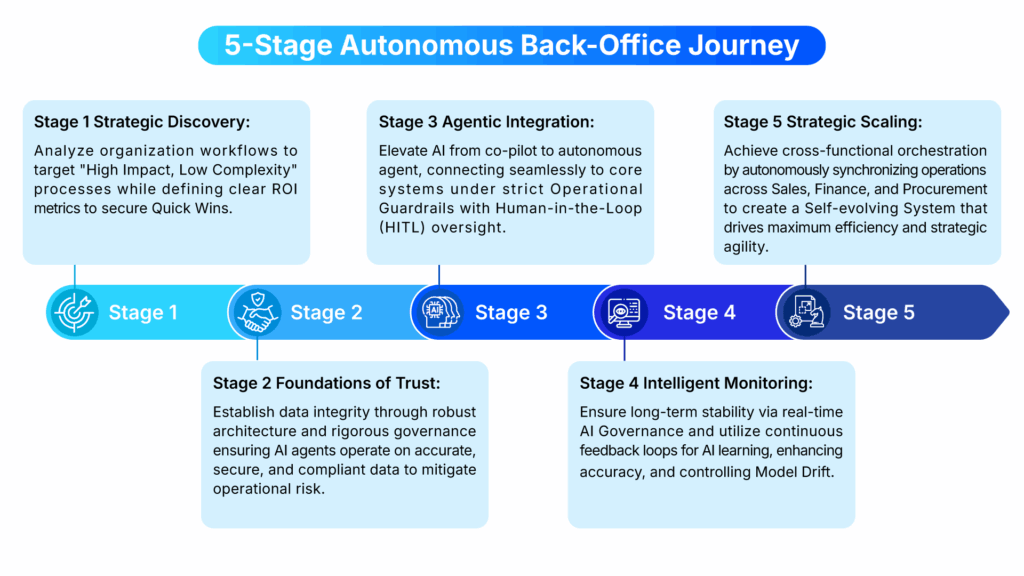
Stage 1: Strategic Discovery – Analyzing organizational structures to identify “High Impact, Low Complexity” processes. This stage focuses on identifying bottlenecks and establishing clear ROI metrics to secure “Quick Wins.”
Stage 2: Foundations of Trust – Establishing data integrity as the bedrock of autonomy. Robust data architectures and rigorous governance frameworks ensure AI agents operate on accurate, secure, and compliant data, mitigating operational risk from the start.
Stage 3: Agentic Integration – Moving from assistant to agent. This involves integrating AI into core systems under strict Operational Guardrails, enabling end-to-end workflows while maintaining Human-in-the-Loop (HITL) oversight for critical decisions.
Stage 4: Intelligent Monitoring – Ensuring long-term stability through real-time AI Governance. By implementing continuous feedback loops, AI agents learn from live environments, improving accuracy, and controlling AI Hallucinations or model drift.
Stage 5: Strategic Scaling – Achieving cross-functional orchestration. AI agents across Sales, Finance, and Procurement synchronize autonomously, creating a Self-evolving System that drives maximum efficiency and fosters the agility needed for new business models.
Autonomous Back-Office: Unlocking Opportunities & Strategic Challenges
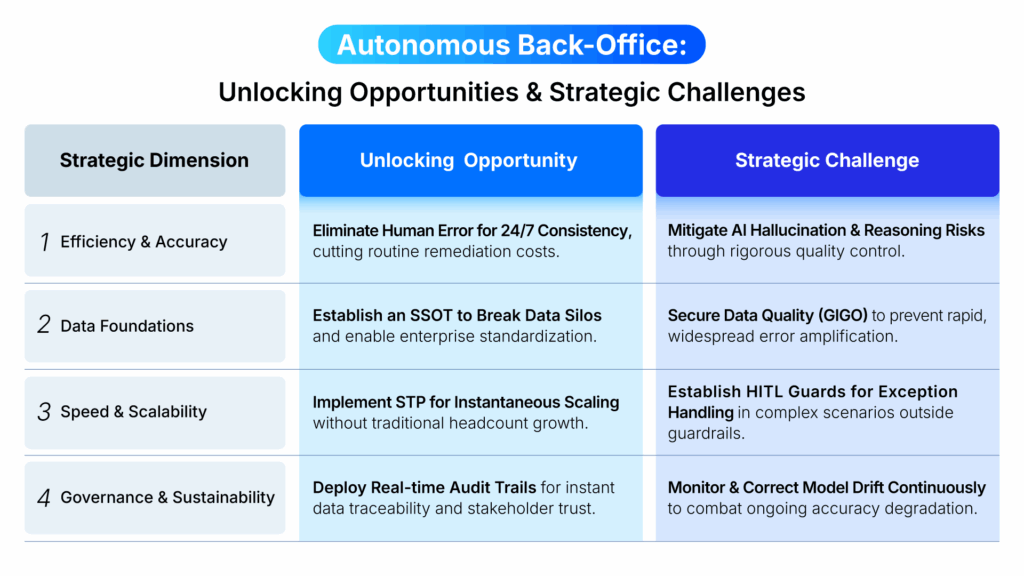
The journey toward an ABO demands a balanced evaluation of operational value versus management challenges.
I. Unlocking Strategic Value: Operational Excellence & Precision
- Achieving Unrivaled Operational Consistency: By automating high-volume, routine tasks, organizations can effectively eliminate human error—the decisive factor in sustaining 24/7 accuracy. This shift fundamentally optimizes cost structures and recaptures the time previously lost to manual remediation.
- Architecting a Single Version of the Truth: Enforcing enterprise-wide data standards transitions the organization from fragmented silos to a unified Data Integrity framework. This “Single Source of Truth” (SSOT) empowers leadership with high-fidelity, real-time insights for agile strategic decision-making.
- Decoupling Growth from Headcount: Implementing Straight-Through Processing (STP) slashes cycle times from hours to seconds. This creates a highly scalable infrastructure that allows for business expansion without the traditional need for proportional increases in personnel.
- Reinforcing Digital Trust through Real-time Governance: Real-time audit trails and granular traceability provide an unprecedented level of transparency. This visibility is mission-critical for building long-term credibility with stakeholders and ensuring seamless regulatory compliance.
II. Navigating Strategic Challenges: Risk & Lifecycle Management
- Guarding against Algorithmic Hallucinations: A primary challenge lies in “AI Hallucinations”—logically sounding but erroneous outputs triggered by data outside the model’s training parameters. Mitigating this requires rigorous quality control and a robust governance framework to protect business logic.
- The Magnified Impact of Data Quality (GIGO): Under the “Garbage In, Garbage Out” principle, any upstream data deficiencies in the foundational stage will be rapidly amplified by autonomous systems. Ensuring comprehensive data readiness is a non-negotiable prerequisite for project success.
- Managing Operational Complexity & Edge Cases: Autonomous systems may struggle with “Exceptions”—complex, non-standard scenarios. Leaders must design sophisticated operational guardrails and a seamless “Human-in-the-Loop” (HITL) framework to ensure these cases are handled with precision.
- Safeguarding Long-term Accuracy against Model Decay: System accuracy is an ongoing commitment, not a one-time deployment. Continuous monitoring and periodic tuning are vital to combat “Model Drift” as business environments evolve, necessitating sustained investment in long-term performance stability.
2026 Industry Use Cases: Autonomy in Action

1. BFSI (Banking, Financial Services, and Insurance)
Global leaders like JPMorgan Chase and Ping An Insurance are pioneering Zero-Touch Lending. AI agents now manage complex contract verification and risk assessments in seconds, reducing turnaround times from days to minutes through fully automated, autonomous workflows.
2. Public Sector and Utilities
Singapore and Estonia serve as global models for Proactive Government Services. By integrating data across agencies, AI agents autonomously verify eligibility and approve public benefits, notifying citizens instantly and drastically reducing administrative burdens.
3. Telecommunications
At MWC 2026, Vodafone showcased its transformation into Zero-Touch Networks. Here, AI agents act as “Intelligent Auditors” for Revenue Assurance, autonomously resolving billing discrepancies and preventing Revenue Leakage in real-time according to business policy.
4. Logistics and Supply Chain
DHL and Amazon utilize Autonomous Supply Chain Orchestrators to manage route volatility and customs clearance in real-time. When unforeseen delays occur at a port, the AI autonomously reroutes shipments and coordinates with destination warehouses to ensure operational continuity.
Conclusion: The Future of Resilience and Growth

Ultimately, the transition to an Autonomous Back-Office represents a fundamental enhancement of the operating model—one that harmonizes peak cost efficiency with the strategic agility required to navigate the digital age. Unlocking the true potential of Agentic AI demands a sophisticated integration of advanced technology and strategic intent, anchored by a foundation of data integrity.
The success of this journey lies not in the mere adoption of tools, but in the expert orchestration of strategic frameworks and data governance that transform autonomous vision into tangible business impact. In the future, true market leaders will be those who can maintain operational excellence while simultaneously driving the continuous evolution necessary to secure a sustainable competitive advantage.