













Transforming AI from a siloed communication tool to an intelligent operating system for a sustainable strategic edge.

Approaching 2026, Response Time has transitioned from a competitive differentiator to a baseline requirement. In this high-velocity landscape, a definitive competitive advantage resides in AI-Enhanced Customer Service. Data from the Salesforce State of the Connected Customer report reveals that over 75% of modern consumers expect businesses to serve as intelligent partners capable of anticipating their needs. To meet this demand, the strategic imperative for organizations is to pivot AI from a front-end communication tool to a core Operational Integration, delivering end-to-end solutions that resolve pain points before they escalate.
The Strategic Frontline: Achieving Zero-Latency Service

Redefining the service function into a Strategic Frontline necessitates the adoption of a Zero-Latency service standard. This approach focuses on mitigating friction points and addressing customer needs before a formal inquiry is even initiated. This shift aligns with the rapid proliferation of Autonomous Agents within customer ecosystems. According to Gartner Predicts 2026, organizations delivering proactive service in this manner can reduce their Churn Rate by up to 25% compared to those utilizing traditional reactive architectures.
Achieving this seamless delivery requires more than superficial automation; it demands the integration of AI into Core Operations. This evolution transforms the system from a mere Information Provider to an engine of Value Orchestration driven by three critical pillars:
- Predictive Intelligence: Utilizing real-time behavioral monitoring to preemptively identify and neutralize potential negative customer experiences before they impact satisfaction.
- Autonomous Resolution: Leveraging Core System Integration to empower AI to execute back-end fixes—such as re-calibrating parameters or processing credits—without manual intervention, governed by sophisticated business logic.
- Contextual Delivery: Orchestrating the communication of results during Micro-moments to transform potential crises into exceptional service experiences that exceed customer expectations.
Strategic Outcomes of AI-Enhanced Service
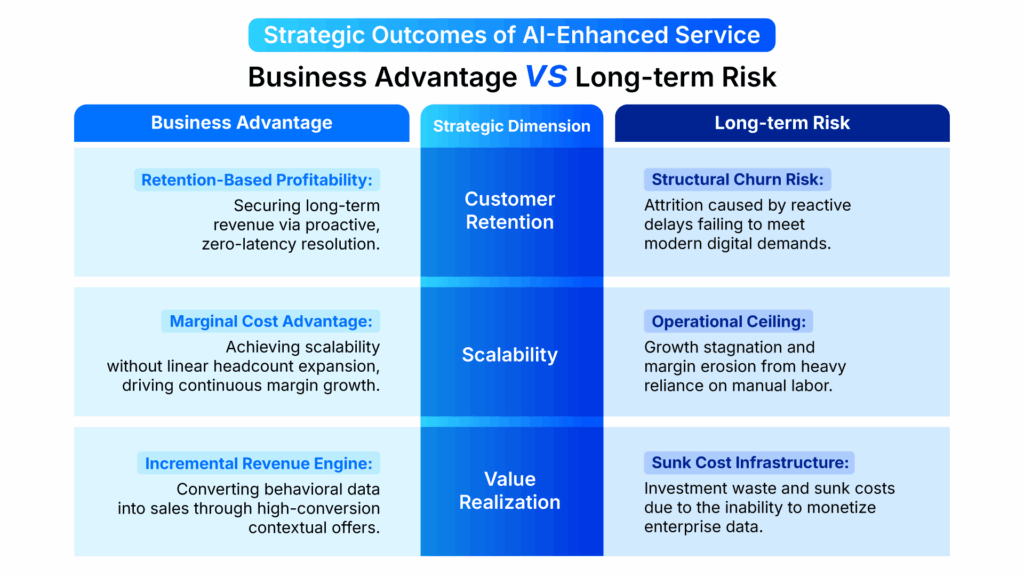
The High Cost of Inaction: Addressing Strategic Debt
Strategic inertia in AI adoption fosters a ‘Strategic Debt’ trap, where the compounding burden of legacy processes stifles future-state agility. This inertia creates long-term vulnerabilities that undermine organizational stability across three critical dimensions:
- Structural Churn Risk: As market expectations shift toward Zero-Latency, reactive support models are becoming a structural liability. Forcing customers to navigate fragmented touchpoints reflects a legacy mindset that is increasingly disconnected from modern digital demands, leading to inevitable customer attrition.
- Scalability and Margin Pressure: Operating models devoid of integrated automation face escalating Marginal Costs. Relying on human capital to manage high-volume, low-complexity tasks inhibit scalability and erode profit margins relative to AI-driven peers who benefit from a more efficient cost structure.
- Failure in Data Value Realization: Inefficient use of enterprise data signifies a failure in Data Asset Management. This results in Data Underutilization, turning significant technological investments into Sunk Costs and depriving the enterprise of the insights necessary to maintain a distinct competitive position.
Business Opportunity: From Cost Center to Revenue Engine
The transition to AI-Enhanced Customer Service represents a fundamental pivot in the service function’s contribution to the enterprise. It moves the department away from the traditional “Cost Center” paradigm, transforming it into a primary driver of sustainable growth and profitability through three key levers:
- Incremental Revenue Generation: Intelligent systems leverage behavioral analytics to transition from support to value creation. By identifying the optimal moment for Contextual Offers, AI enables high-conversion upselling and cross-selling that directly increases customer lifetime value.
- Scalability & Marginal Cost Advantage: An End-to-End intelligent architecture facilitates rapid transaction growth without a linear increase in headcount. This achieves significant Economies of Scale and a superior marginal cost structure, providing a dominant advantage over competitors reliant on traditional personnel scaling.
- Retention-based Profitability: Given that the cost of acquisition exceeds the cost of retention, Zero-Latency service directly stabilizes the bottom line. Reducing churn through proactive resolution provides a more sustainable profit path than relying on perpetual marketing spend to replace lost users.
Strategic Framework: Elevating Service into an Intelligent Operating System
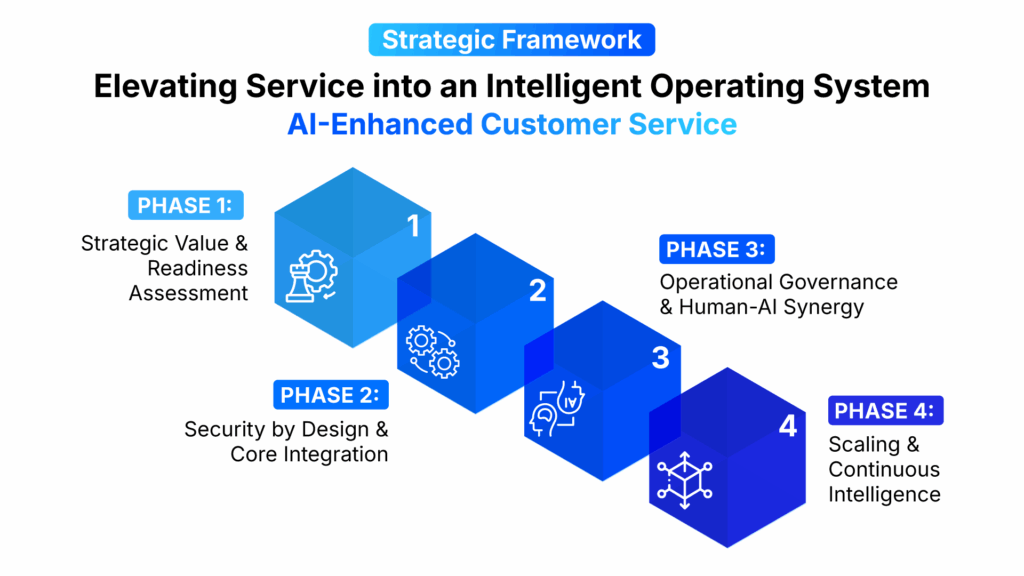
To ensure AI moves beyond isolated pilots to a scalable enterprise capability, organizations must adopt a disciplined transformation methodology. This approach focuses on fostering long-term resilience and realizing sustainable value through four distinct maturity phases:
Phase 1: Strategic Value & Readiness Assessment
Before initiating technical deployment, the organization must identify high-impact opportunities and conduct a formal Operational Readiness Review (ORR). This phase ensures that AI investments are directed toward areas with the highest potential for ROI and that the organization is structurally prepared for the transition.
- Prioritizing High-Yield Use Cases: Analyze and select operational areas characterized by high Marginal Costs or significant Churn Vectors. Focus on segments where proactive AI intervention can deliver a measurable impact on the bottom line during the initial rollout.
- Data Integrity and Infrastructure Diagnostic: Conduct a comprehensive evaluation of Data Readiness and existing security postures. Identifying infrastructure gaps and data silos at this stage is a critical imperative to mitigate risks and ensure the long-term success of the AI integration.
Phase 2: Security by Design & Core Integration
Transitioning AI from a mere ‘Information Provider’ to an Autonomous Agent requires a deep integration into the enterprise’s digital foundation. This phase focuses on creating a seamless flow of data and actions across the entire technology stack.
- Integrated Core Architecture: Establishing a singular source of customer truth is the cornerstone of dissolving data silos. By anchoring AI within the enterprise’s digital core, the platform leverages holistic context to drive straight-through, autonomous resolution, effectively eliminating manual intervention.
- Proactive Security & Zero-Trust Frameworks: Proactive Security & Zero-Trust Postures: Integrating Security by Design into the architectural baseline ensures that data privacy and regulatory compliance are intrinsic to the system. Adopting a Zero-Trust posture not only fortifies sensitive assets but also serves as a strategic hedge against future technical debt and the evolving digital threat landscape.
Phase 3: Operational Governance & Human-AI Synergy
Autonomous operations demand a robust governance framework to maintain control and protect the brand’s integrity. This phase establishes the “rules of engagement” for AI, ensuring that technology and human expertise work in perfect orchestration.
- Establishing AI Guardrails and Governance: Define strict operational boundaries and ethical frameworks for AI decision-making. These Guardrails must align with business logic and legal requirements to prevent technical anomalies and preserve Digital Trust across all customer interactions.
- Seamless Human-AI Hand-off Models: Design integrated workflows that allow for a frictionless transition between AI and human agents. This is particularly vital for high-complexity cases or scenarios requiring emotional intelligence, ensuring a flexible and high-empathy service experience.
Phase 4: Scaling & Continuous Intelligence
The final phase focuses on achieving Scalability while maintaining peak performance. As the organization grows, the AI system must evolve through continuous learning and broader operational reach.
- Feedback Loops and Model Optimization: Implement a continuous Feedback Loop that utilizes real-world interaction data and customer sentiment to refine AI models. This iterative process prevents “model drift” and ensures that AI decisions remain strictly aligned with the evolving corporate strategy.
- Omnichannel Expansion and Operational Resilience: Scale the AI-enhanced architecture across all touchpoints to ensure consistency and availability. This expansion facilitates rapid business growth while maintaining a superior and cost-efficient marginal cost structure over the long term.
Global Benchmarks: AI-Enhanced Customer Service in Action

Leading enterprises are leveraging AI-enhanced service to fortify their value chains. Real-world evidence illustrates that an anticipatory shift secures customer loyalty and a definitive competitive advantage—laying the foundation for sustainable, long-term growth.
1. Klarna: Scaling Operational Efficiency through AI-Driven Support
Klarna, a global fintech leader, demonstrates how AI manages complex, high-volume service ecosystems with seamless precision. By prioritizing AI-led interactions, the organization has successfully decoupled business growth from headcount expansion.
- Strategic Mechanism: The integration of a sophisticated AI Assistant directly into the transaction core and customer database allows the system to handle end-to-end financial inquiries. This orchestration enables the AI to process refunds, manage disputes, and provide personalized financial insights without manual intervention.
- Measurable Impact: Within its first month, the system managed a workload equivalent to 700 full-time agents, reducing average resolution time from 11 minutes to under 2 minutes. This efficiency is projected to drive a $40 million annual profit improvement while maintaining customer satisfaction on par with human agents.
2. Tesla: Redefining Digital Trust through Predictive Maintenance
Tesla transcends conventional after-sales support by leveraging real-time telematics to resolve vehicle anomalies before they impact the driver. This “invisible” service paradigm serves as a cornerstone for building long-term brand equity and customer confidence.
- Strategic Mechanism: Utilizing an extensive network of onboard sensors and edge AI, Tesla continuously monitors vehicle health. When the system identifies a potential component failure, it can autonomously trigger a parts order and route it to the optimal service center before the user is even aware of the issue.
- Measurable Impact: This proactive diagnostic loop transforms the ownership experience. By neutralizing the inconvenience of unexpected breakdowns, Tesla solidifies a level of Digital Trust that sets out a new benchmark for the luxury automotive sector.
3. Netflix: Anticipatory Delivery for a Zero-Latency Experience
Netflix defines service excellence through technical seamlessness. By deploying predictive algorithms to manage global data distribution, the company has neutralized the streaming industry’s primary friction point: latency.
- Strategic Mechanism: Leveraging Predictive Caching, Netflix analyzes viewing trends to pre-position high-demand content at the network edge. Through its Open Connect infrastructure, the system anticipates user intent and distributes data to local servers prior to user initiation.
- Measurable Impact: This proactive traffic orchestration ensures a Zero-Latency perception. By eliminating buffering, Netflix sustains superior engagement and reinforces its status as the gold standard for streaming reliability.
4. Amazon: Anticipatory Fulfillment and Operational Moats
Amazon has redefined customer service by pivoting from reactive speed to anticipatory fulfillment. By pre-empting order latency before a transaction occurs, the organization has built a formidable competitive moat.
- Strategic Mechanism: Utilizing patented Anticipatory Shipping algorithms, Amazon analyzes historical intent to forecast demand at a granular level. The system stages inventory at localized fulfillment centers prior to a purchase, effectively decoupling the logistics cycle from the moment of transaction.
- Measurable Impact: This model compresses delivery windows from days to hours, significantly reducing purchase friction. This proactive stance has established an unrivaled industry benchmark for fulfillment efficiency and customer retention.
Conclusion: From Insights to Actionable Digital Trust
In the AI-First era, leadership is defined by the capacity to operationalize intelligence—converting raw data into immediate, value-driven action. Beyond mere cost-efficiency, AI-enhanced service establishes a structural advantage that fortifies long-term organizational resilience. Ultimately, by mastering pre-emptive resolution, organizations cultivate a level of Digital Trust that serves as a formidable moat in an increasingly autonomous landscape.