













Bluebik Group Public Company Limited (BBIK), a leading consultancy in digital enterprise transformation, recommends Thai organizations have strategies for the systematic migration of their information technology systems from their premises to the cloud (cloud migration). This builds foundations for the organizational transformation that is based on cloud computing (cloud transformation). Cloud technology becomes core infrastructure apart from being a tool to cut IT costs. Organizations can launch new services faster, expand their systems in proportion to their growth, enhance flexibility and security and apply new technologies like artificial intelligence and advanced analytics efficiently.
Pochara Arayakarnkul, Chief Executive Officer of Bluebik Group Public Company Limited (BBIK), said that when business competition depends on speed, data and adaptability, the organizations that continue to use conventional IT infrastructures are subject to severer constraints concerning costs, the complicated structures of conventional IT infrastructures (legacy infrastructure), security risks and the limitation of data application to create business value. Cloud migration provides organizations with the infrastructures that support their future growth. However, the fastest migration or “lift and shift” alone does not guarantee successful cloud migration. The process must begin with comprehensive assessment, the selection of appropriate migration methods and organized project management. Cloud migration should not be carried out across the board and one method of cloud migration does not fit all systems.
Pochara Arayakarnkul, Chief Executive Officer of Bluebik Group Public Company Limited (BBIK), said that when business competition depends on speed, data and adaptability, the organizations that continue to use conventional IT infrastructures are subject to severer constraints concerning costs, the complicated structures of conventional IT infrastructures (legacy infrastructure), security risks and the limitation of data application to create business value. Cloud migration provides organizations with the infrastructures that support their future growth. However, the fastest migration or “lift and shift” alone does not guarantee successful cloud migration. The process must begin with comprehensive assessment, the selection of appropriate migration methods and organized project management. Cloud migration should not be carried out across the board and one method of cloud migration does not fit all systems.
Phiradol Koopthavonrerk, cloud migration specialist at Orbit Digital Company Limited under Bluebik Group, said that what are frequently overlooked are the analysis of connection and dependency among systems and performance baseline determination before system migration. Unless organizations see how the workloads of systems are connected, how many resources they consume and what are their latency requirements, it is difficult for them to work out a suitable migration strategy.
“Without a clear framework, organizations may succeed in technical cloud migration but the migration may not benefit their business. So, cloud migration must cover system assessment, strategy formulation, execution, follow-ups and the management of parties concerned to make the cloud be not only a new form of IT infrastructure but also the foundations for growth,” Miss Phiradol said.
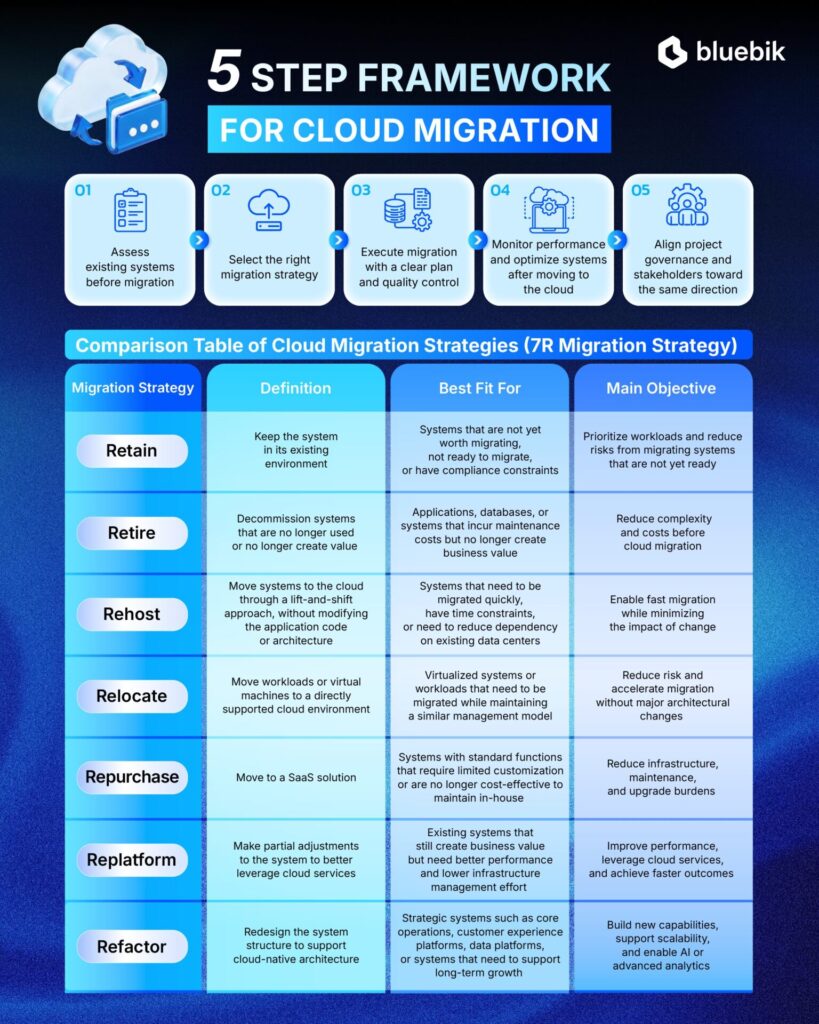
Bluebik shares its 5-step framework for cloud migration. With the framework, organizations can develop systematic cloud migration plans which cover understanding about old systems, the selection of suitable migration strategies, operations with risk management, follow-ups and post-migration optimization. With the framework, cloud migration will create real and long-term business value. The framework consists of 5 important steps – the comprehensive assessment of old systems before migration, the selection of suitable migration methods, execution with plans and quality control, follow-ups and post-migration optimization and the alignment of project management and parties concerned.
1) Comprehensive assessment of old systems before migration
The first step of cloud migration is to thoroughly assess the existing systems of organizations. The assessment covers infrastructures, applications, databases, system integration and the actual resource utilization. The assessment will show the systems that are vital to business, the systems that have technical limitations, the systems that pose risks and the levels of cloud migration compatibility of systems.
Good system assessment should involve IT infrastructure inventories, application assessment, database assessment, dependency mapping, security and compliance assessment and performance baselines. Data collected from the assessment provide a basis for the design of desired architecture, the determination of resource sizes on the cloud and the formulation of migration plans that suit actual use.
2) Selection of suitable migration methods
After understanding all systems, organizations must select suitable migration methods. They should not choose a single method for the migration of all systems because different systems have different business significance, technical complication and levels of migration readiness. Migration strategies are as follows.
- Retain – Some systems will remain in their conventional environment if their migration is unnecessary or is not worth investment, their existence in the cloud is planned to be short-lived or there is any security or legal limitation.
- Retire – Unused systems are shut down.
- Rehost – Existing systems are migrated to the cloud immediately without a code change. This can be done quickly and suits mass migration.
- Relocate – This refers to virtual machine (VM) migration from old environments to new ones with few changes.
- Repurchase – Software-as-a-service (SaaS) solutions are adopted.
- Replatform – Systems are migrated to the cloud and some components are adjusted to enhance efficiency.
- Refactor – System refactoring is carried out for the maximum use of cloud-native architecture.
Bluebik takes the view that replatform and refactor highly benefit business value especially for the organizations that need to accelerate system development to support future growth and use cloud-native services effectively.
3) Execution with plans and quality control
Execution is the migration of systems to the cloud. It covers infrastructure configuration, the preparation of new environments, the migration of system workloads, the relocation of databases, the code changes and pipeline adjustments that are necessary, system tests and cutovers in difference environments. This concerns system integration tests (SIT), user acceptance tests (UAT) and production, for example.
For the systems that are complex and considerably connected, wave-based migration allows organizations to migrate systems in stages, reduce risks and handle impacts on business more effectively than all-in migration.
Moreover, organizations should have clear plans to cope with the problems that may occur during migration, especially problems with the systems that are crucial to business operations or must be operational around the clock.
4) Follow-ups and post-migration optimization
Cloud migration is not complete on the day when systems are successfully migrated to the cloud. Organizations must keep following up the functions of systems and finetuning them to guarantee that new systems can operate as planned when it comes to efficiency, stability, security and costs.
After cloud migration, organizations should set their systems to support key areas including security, data backups, system supervision and cost optimization. Organizations should also follow up important indicators and cloud costs in order to find opportunities to have the resources that suit actual use, cut unnecessary use and maintain cloud contributions to business value after systems go live.
5) Alignment of project management and parties concerned
Cloud migration is the kind of transformation that concerns many parties including executives, business units, IT teams and users. Therefore, a cloud migration project and the parties concerned must be managed systematically so that everyone shares a common goal from the start.
For highly complicated migration projects, experts in strategies, technologies and the management of large-scale projects (strategic PMO) can reduce risks and increase the probability of success. If cloud migration is in experts’ capable hands, it will mean not only the migration of systems to the cloud but also the greater degrees of competitiveness, growth and flexibility of the organizations that carry out cloud migration.
“As technology controls the speed of business, organizations should not postpone their cloud migration projects until their existing systems cease to function. This is the strategic decision that should be translated into action right away. As some organizations remain too reluctant to migrate their systems to the cloud, their competitors may be applying the cloud to create new services, reduce the limitations of their existing systems and further develop their AI or data analytics for their competitive edge,” Mr. Pochara concluded.
Therefore, cloud migration means to move not only systems but also organizations to new levels of competitiveness. The organizations that start their cloud migration correctly can reduce risks, control costs and make the cloud a vital tool for sustainable business value.
For more information about Bluebik, please visit www.bluebik.com. Bluebik also provides updates via its “Bluebik Group” account on Facebook and LinkedIn.