













For Stang, one of Bluebik’s sharpest business consultants, the path to where she is today wasn’t conventional. She didn’t study business but Communication Arts, which is quite far from corporate strategy and organizational transformation. But through focused effort and commitment to continuous growth, she climbed the ranks faster than most.
Stang graduated from the Faculty of Communication Arts at Chulalongkorn University’s international program. Around her third year, she was drawn to business problem-solving and joined her university’s Consulting Club. That was the turning point. Through the club, she got her first real exposure to consulting, and when a senior Bluebik consultant shared their experience, an internship opportunity followed. She joined Bluebik as an intern, converted to a full-time role after graduation, and, within 3.5 years, became a manager.
Today, Stang is a Manager on Bluebik’s Management Consulting (MC) team. Her work covers a wide spectrum: helping organizations define long-term strategy over 5 to 10 years, improving operational efficiency, and solving technology challenges that enable sustainable digital transformation. That’s the broad picture. But the real depth of what the MC team does and what it takes to be excellent is a much richer story. Stang shares it all here, including the skills that drive excellence in consulting and the 5 areas where she’s seen the most growth in Bluebik’s unique environment.
How MC Works: A Deep Dive into Bluebik’s Management Consulting Process
“Every project has its own approach, but there’s a baseline that applies across all of them. The first thing we always do is identify the real problem, the actual Problem Statement. We need to understand what the client is truly trying to fix or build before we do anything else,” Stang explains.
“From there, we form hypotheses to define what the solution needs to cover and what we need to validate. Once that structure is in place, the next step is an organizational Assessment, where we evaluate the client based on the areas we’ve mapped out. Depending on the project, that might mean assessing workforce readiness, reviewing existing strategies, or analyzing financial health. The goal is to clearly see the gaps, to understand what’s standing between the organization and where it wants to be, and figure out exactly where we need to step in.”
Designing a strategy with the strategy team alone isn’t enough. You have to work alongside the operational teams who will put the strategy into practice. That’s why Bluebik’s MC team takes it further, stress-testing the strategy against real operational constraints and identifying missing pieces so the final Roadmap is one that the team can execute.
Stang uses a building analogy to describe how the work comes together:
“On day one, we collect the client’s requirements. We need to understand the concept they’re aiming for, whether modern or traditional, and their specific constraints like land shape, sun direction, or if there’s an existing structure to renovate or if they want to start from scratch.”
“From all that, we figure out what the Blueprint should look like. How many floors? How many rooms? What is each space designed to do? The goal is to create something that answers the client’s vision while working within real-world constraints. That part is a lot like what an architect does.”
“The other half is closer to engineering. In each project, we’re not just designing how things look. We must ensure the structure works, is safe, and functional. The electrical systems, plumbing, and load-bearing elements. In many projects, we go that deep.”
“At the end of the day, our job is to clearly assess each client’s strengths and weaknesses, understand the readiness of their systems and people, and design a strategic plan that genuinely addresses their needs by considering their full context.”
What Makes an Excellent Consultant at Bluebik: The Skills That Get You There
In Stang’s view, there are three foundational skills every good business consultant needs to have:
1. Structured Thinking
“When clients come to us, they usually bring messy, complex problems. Some don’t yet have a clearly defined scope. It’s our job to break down that complexity and uncover the core of what they need. From there, we identify the Key Drivers, the factors with the most impact, and prioritize what matters most for solving that problem. This structured thinking is the baseline for anyone who wants to do this work well.”
2. Critical Thinking
“Critical thinking is something senior colleagues have always emphasized. It’s about framing the right questions, challenging your assumptions, and digging until you find the real answer. If you set the wrong problem statement on day one, everything that follows is built on a flawed foundation. If you never question your thinking, the output ends up surface-level, not specific or deep enough for the client or challenge.”
3. Story Lining
“As you grow in this field, your ability to structure and communicate a narrative becomes more important. It’s not just about presenting findings. It’s about choosing how to sequence the story, deciding which angle to tell it from, and building a line of reasoning that leads to real understanding and action. The heart is connecting all the work across the project into something coherent that the client can follow and act on.”
“You also need to communicate differently depending on who’s in the room. Some clients want full details. Others need it pre-digested and ready to apply immediately. Knowing how to present in a way that’s convincing and on-point is a skill you keep sharpening.”
Beyond the three core skills, moving into a Manager role brings another layer: people and project management.
“As a Manager, you’re responsible for internal and external project management. Internally, that means assessing the team’s capacity and timeline, deciding who owns which workstream and how much time each should take, and actively developing junior team members’ skills so the project moves toward its goals.”
“On the client side, you manage diverse stakeholders, and each organization has its own dynamic. Some clients want frequent touchpoints and close collaboration. Others prefer fewer, more comprehensive updates. As a Manager, you must allocate your team’s time and attention to meet client needs without creating friction for the team.”
On what Excellence actually means in this field, Stang is clear:
“Excellence in consulting isn’t about producing a polished deliverable. The real measure is whether the plan we put forward can actually be implemented, whether it creates real value for the client, and whether the outcomes are something you can tangibly measure.”
“One important technique we use is consistently checking the Depth and Specificity of everything we put forward. Before anything goes out, I always ask the team: “Is this recommendation specific enough for this client?”
“A simple test I use: if I could take this statement and apply it to a different client, it probably isn’t specific enough. If the advice works for everyone, it’s not actionable for anyone. So we always pressure-test the depth and clarity of our work against the client’s context.”
Growth Environment at Bluebik: How the Culture Here Accelerates Your Development
When asked how she made it to Manager in just 3.5 years, Stang’s answer is direct: “Bluebik already creates the conditions for people to grow fast.”
“One reason it worked for me is that throughout those 3.5 years, I worked on a wide variety of projects. That exposure gave me the chance to challenge myself in different ways and prove to myself and others that gaps from not having a business background could be closed through the work itself.”
“Some projects, I started from zero, but had to push through to a hundred. There was a Tech Transformation project with a company in Vietnam. I was embedded with a client as a PMO for about 6 months. Right now, I’m working on a project that delves deep into financial skills. These experiences push you to grow in real time, and the people who see that growth are your clients and leadership. I think that’s part of why the promotion came when it did.”
Because Bluebik runs projects across so many industries, Stang has been in a constant learning mode, getting up close with the real constraints that different sectors operate within.
“If you only imagine how things work without doing them, you’ll never see the full picture. Real experience gives you a foundation to build on. The Directors and Associate Directors here are open to letting you step into projects you want to grow through. There’s space to have conversations about where you want to go and what work you want to take on. That’s why I’ve never stopped developing.”
When asked about the most challenging project she’s tackled, Stang walks through the scope of a current engagement:
“Sometimes the scope is enormous. The project I’m working on right now is a full Organization Transformation across every dimension. It starts with Business Transformation, mapping the future direction of the business, which customer segments to focus on, and what product model to drive forward. That alone is already a complex challenge.”
“Then there’s Process Transformation, looking at how both front-end and back-end operations need to evolve to support the new business direction efficiently.”
“Alongside that is Tech Transformation, building out a technology roadmap that identifies which systems to adopt and where AI can reduce manual workload and improve overall performance.”
“And finally, there’s the People dimension. Reorganizing the structure of the organization so it can actually deliver on everything that’s been planned, with the right Governance in place for the new direction.”
“When the scope is this wide, you must ensure the entire team understands all four dimensions: Business, Process, Tech, and People from the start. That way, you can design the full set of recommendations within the timeline. It’s challenging because you’re assessing the organization across every layer and communicating with stakeholders at every level, from operations teams to the C-suite. But it’s one of the most rewarding projects to work on. Everyone on the team grows a lot through it.”
5 Areas of Growth: From a Non-Business Background to MC Manager
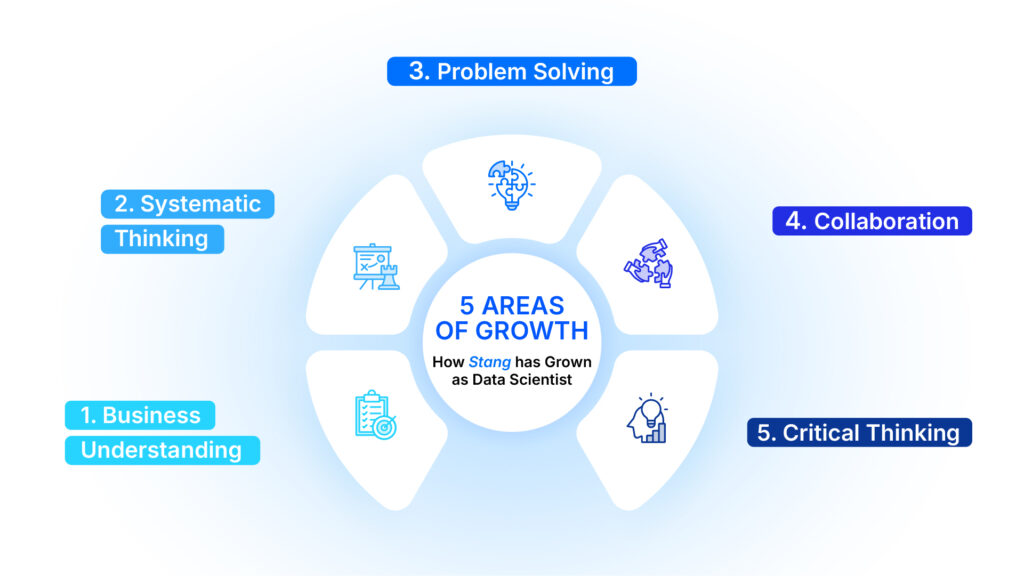
After years of challenges and diverse projects, here are the 5 areas where Stang sees the clearest, most meaningful growth in herself:
1. Business Understanding
“Consulting is a front-row seat to how businesses actually work. You get to work with people from every level, from executives setting strategy to the teams executing it day to day. Each person sees the business differently, and getting close enough to assess an organization from the inside out gives you a depth of understanding that’s hard to get any other way. You start to see how everything connects, end to end, from the front of the house to the back.”
2. Systematic Thinking
“Building a structured way of thinking has been core to developing in this field. Early on, every time I faced a new problem, the first step was to build the thinking framework: what structure makes sense, what to research, and how to synthesize findings clearly. As you grow, you shift from managing your own workstream to overseeing the entire project. That muscle sharpens with every project.”
3. Problem Solving
“Consulting is about solving problems, but it’s not just the business challenge. It’s all the real-time problems during execution. Time is limited. Resources are constrained. Different stakeholders have different conditions. Dependencies across workstreams can’t always be predicted. Things rarely go perfectly, so you must get good at improvising intelligently, keeping teams moving, and delivering the project on time.”
4. Collaboration
“You work with many people in this job. You’re managing relationships within Bluebik and across multiple client teams simultaneously. You must learn to work effectively with each person and communicate in a way that fits their context. That skill builds through experience and trial and error. Early in your career, you may have little exposure to senior executives and miss what they don’t say directly. Over time, you develop the ability to read between the lines and understand what someone needs, even when it’s not spelled out. That’s what makes you genuinely useful to a client.”
5. Critical Thinking
“This is where I’ve seen the most personal growth and am most aware of it. Some of us grew up without being taught to challenge our thinking. Consulting is essentially that, constantly questioning what you believe. My senior colleagues pushed me to ask harder questions about my ideas because accepting the first answer without digging deeper leads to shallow work. This job trained me to keep asking: ‘Is this really the right answer?’ and ‘If not, what else is possible?’ Comparing now to day one, that shift is the clearest thing I can point to.”
Consulting Career Guide: A Few Words for Anyone Considering This Path (Especially If Your Degree Doesn’t Match)
“A lot of people hesitate to step into business consulting because they think you need a business degree or a background in competitive case work. But honestly, that’s not the whole picture,” Stang says. And her own career is the proof.
“I studied Communications. When I started my internship, I had to put in extra effort on hard skills, quantitative thinking, business logic, data analysis, and drawing insights. But I believe those are learnable skills. They develop through doing. You just have to push yourself harder in the beginning to get up to speed quickly.”
“What I want to tell anyone considering this path is: you don’t need a business degree to be a great consultant. Everyone can learn and grow. Just make sure those three foundational skills are somewhere in your toolkit, and you’ll be ready to take the first step with confidence.”
Stang’s story proves that not having the “right” degree is not a barrier to building a meaningful consulting career. It takes commitment to keep developing, openness to challenge yourself through real work, and an environment designed to help you grow.
If you’re a consultant looking for work that genuinely challenges you and makes you better every day, we’d love for you to be part of our Management Consulting team. Apply now at bluebik.com/th/job or send your CV directly to [email protected].