













As organizations begin adopting AI in practice, a common gap emerges between expectation and reality. Some executives expect a single AI solution to handle everything — from sales forecasting and production planning to supply chain management. In practice, however, each type of business problem calls for different data, analytical methods, and decision-making processes.
Businesses in manufacturing, retail, and services must plan amid multi-dimensional complexity: fast-shifting demand, inventory levels, machine capacity, labor constraints, and transportation costs and lead times. These challenges can rarely be fully addressed by a single type of model.
This is where the concept of Multiple AI Models for Planning and Forecasting comes in — a system design approach that brings together AI models, Machine Learning techniques, and Mathematical Optimization, each playing a distinct role, to support forecasting, planning, and business decision-making in a connected way.
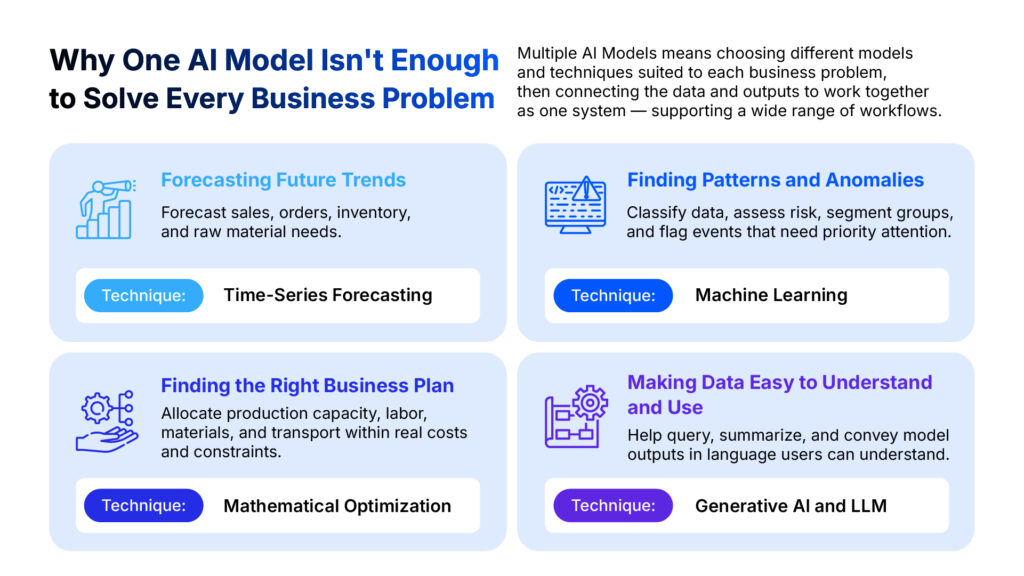
Why a Single AI Model Isn’t Enough to Solve Every Business Challenge
Business planning isn’t just about predicting what will happen next. It also covers choosing the right plan, allocating resources, detecting anomalies, and helping users understand data well enough to act on it. These varied needs can’t be fully met by a single AI model.
Applying Multiple AI Models doesn’t mean automatically stringing together as many models as possible. It means selecting the right AI models, Machine Learning techniques, and Mathematical Optimization methods for each role, and designing the data and outputs to work together as one system.
Forecasting Future Trends and Demand
Organizations can forecast sales, orders, inventory levels, or raw material needs over time to inform production, procurement, and distribution planning. This may draw on Time-Series Forecasting — from statistical models like ARIMA, to forecasting methods such as Prophet, to Machine Learning or Deep Learning approaches like LSTM. The right approach depends on the nature, volume, quality, and complexity of the data.
Finding the right plan under real-world constraints
Once future trends are known, organizations still need to decide how to allocate production capacity, labor, materials, warehousing, and transportation — to control costs, maintain service levels, or maximize resource use. These problems call for Mathematical Optimization, such as Linear Programming, Mixed-Integer Programming, or Constraint Programming, to find the best or most feasible plan given the objectives, assumptions, data, and constraints built into the model.
Classifying data, spotting patterns, and detecting anomalies
AI can help assess whether a customer is likely to make a repeat purchase, flag orders with unusual patterns, group products and suppliers with similar characteristics, or categorize them by risk level — helping teams filter and prioritize large volumes of data faster. This draws on Machine Learning techniques such as Classification, Clustering, and Anomaly Detection.
Making model outputs easier to understand and act on
Users can query, summarize, and understand forecasting and optimization results through accessible language, using Generative AI and Large Language Models (LLMs) as a conversational channel that explains the details. However, the system must connect the LLM to source data, evidence, assumptions, constraints, and model outputs in a controlled way — with the LLM tasked with organizing and conveying information the system has already computed, rather than generating new reasoning without underlying data.
When these capabilities work together, organizations gain more than a view of what might happen next — they can evaluate options, plan resources, and make decisions under real constraints in a far more systematic way. This is what elevates AI from a point-solution analytics tool into an enterprise-level decision-support system.
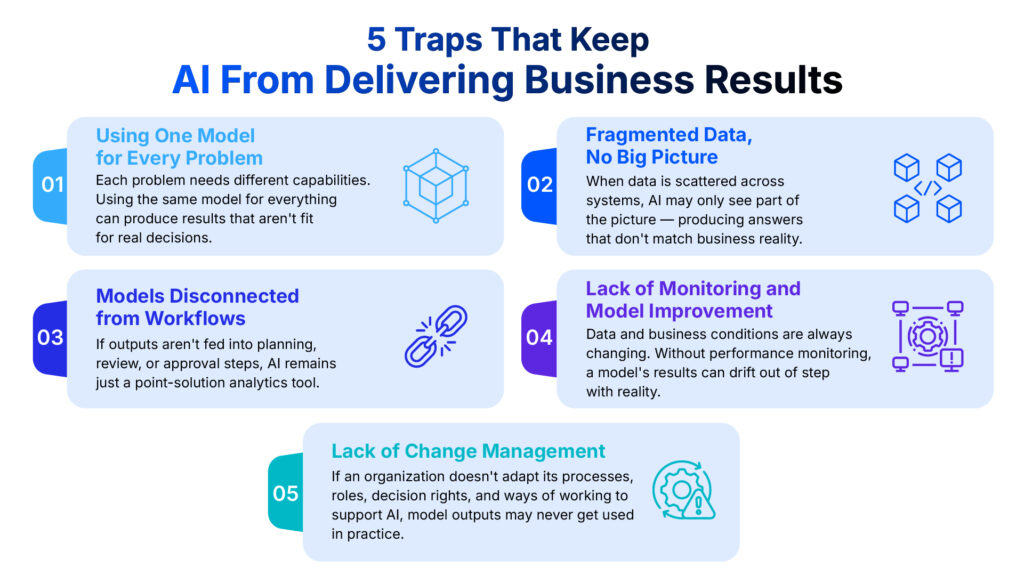
The Strategic Gap: Traps That Keep AI From Delivering Business Results
Many organizations have begun investing in AI to improve planning and forecasting, but success doesn’t depend on having the most capable model alone. It also hinges on data quality, system integration, workflows, governance, and whether the outputs are actually used to make decisions.
Trap 1: Single-Model Thinking
Different problems call for different capabilities. Demand forecasting needs a model that reads trends from time-based data, while resource allocation needs an Optimization Model that calculates within real-world constraints. Using one model for every problem may produce results that look credible but aren’t fit for operational decision-making.
Trap 2: Data Silos That Block the Big Picture
Critical data is often scattered across ERP, CRM, WMS, TMS, IoT systems, or individual team spreadsheets. When data isn’t connected, AI may only see part of the picture — sales without production capacity, or stock levels without transportation constraints — producing answers that are correct in isolation but don’t reflect the business as a whole.
Trap 3: Missing Integration and Orchestration Layer
Having multiple models doesn’t automatically make a system smarter. If outputs from each model can’t flow systematically into planning steps or related systems — whether through automation or a human review-and-approval process — teams still have to act on the data manually, and AI remains an analytical tool rather than a mechanism supporting end-to-end decisions.
Trap 4: Model Drift and Insufficient Performance Monitoring
An AI model isn’t something built once and used forever. Customer behavior, seasonality, input costs, and the broader business environment are constantly shifting. As the data patterns feeding a model change, or as the relationship between inputs and outputs shifts, model performance can degrade or drift out of step with current conditions. Organizations need monitoring, alerting, and review processes that cover Data Drift, Concept Drift, Prediction Drift, and business performance — which may call for retraining, recalibration, fixing the data pipeline, adjusting features or thresholds, or replacing the model as needed.
Trap 5: Lack of Change Management
Even a well-performing model may fail to create business value if teams don’t understand it, trust it, or act on its insights. Organizations need to redesign processes, roles, and decision rights, and explain the reasoning behind recommendations so users can review and apply the results appropriately.
Successfully deploying Multiple AI Models therefore requires designing the data foundation, model architecture, integration, governance, monitoring, and change management to work together — not focusing on technology or model accuracy alone.
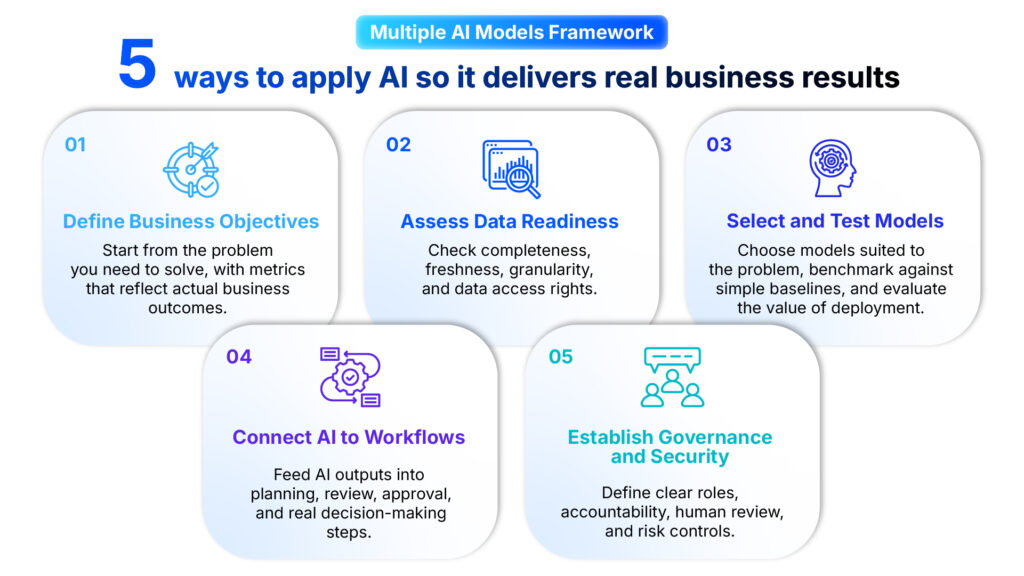
Strategic Framework: How to Apply Multiple AI Models Successfully
Phase 1: Define Clear Business Objectives and Metrics
Organizations should start from a business problem — reducing inventory costs, improving demand forecast accuracy, cutting lead time, raising OTIF, or improving machine utilization — and define metrics tied to business outcomes, not just model accuracy.
Phase 2: Assess Data Readiness
Conduct a Data Availability and Quality Assessment covering ERP, CRM, WMS, TMS, IoT, and external data such as weather, raw material prices, market trends, or economic indicators. Check completeness, continuity, freshness, granularity, point-in-time correctness, and data access rights to prevent data leakage and ensure the data matches the required forecasting level.
Phase 3: Design the Model Architecture and Evaluate Systematically
Select models suited to the problem, compare them against a baseline, and test on data the model hasn’t seen before. A baseline may be a simple non-AI method — a historical average, a seasonal naive forecast, a business rule, or the forecast a team currently produces manually — particularly using time-based validation for forecasting tasks. Choose metrics that reflect the business cost of errors, rather than selecting a model on accuracy alone, and assess whether the added benefit justifies the cost and complexity of building and maintaining the system.
Phase 4: Connect AI to the Business Workflow
AI outputs shouldn’t stop at a dashboard. They should feed into procurement, production, distribution, transport scheduling, workforce planning, or S&OP meetings — with clear definitions of which steps run automatically, which need human review, and which require approval.
Phase 5: Establish Governance, Security, and Human Oversight
AI’s role should be scaled to the risk and impact of each use case. Low-risk tasks may run automatically within guardrails, while high-impact decisions need clear human oversight and an audit trail. This should also cover data privacy, access control, model and data lineage, version control, and monitoring of LLM-specific risks such as hallucination, prompt injection, and inappropriate data disclosure.
Use Cases Across Industries
1. Manufacturing and Supply Chain
Forecasting models can help predict demand and raw material needs, while optimization models use that data to plan machine capacity, labor, and production sequencing under real constraints. Combined with inventory and route optimization, this approach can help reduce excess inventory, improve logistics efficiency, and support on-time delivery.
2. Retail and Consumer Goods
Multiple AI models can help forecast sales by product, store, or channel — factoring in seasonality, pricing, promotions, customer behavior, and external factors. Linked to inventory optimization and replenishment planning, businesses have the opportunity to reduce stockouts, cut excess inventory, and plan promotions more closely aligned with demand.
3. Banking and Finance
Forecasting models can support predictions of loan demand, transaction volumes, and cash flow, while risk models assess customer risk, loan portfolio risk, or transaction anomalies. Linked with optimization models, organizations can plan resource allocation and manage capital more systematically — all under appropriate regulatory compliance, review, and human oversight.
4. Energy and Utilities
AI can help forecast energy demand based on weather conditions, fuel costs, and system constraints, while predictive maintenance models assess equipment risk. Linked with optimization models, organizations gain the potential to plan production, allocate energy, and schedule maintenance with less service disruption.
5. Healthcare and Hospitals
Forecasting models can help estimate patient volumes by time period, department, or season, then connect with resource optimization to support planning for doctors, nurses, beds, and medical supplies. That said, this use requires careful attention to data privacy, security, and decisions made by qualified medical staff.
6. Logistics and Transportation
Multiple AI models can help forecast parcel or order volumes by area, and use optimization algorithms to plan routes, vehicle rounds, warehousing, and workload distribution. With real-time data — traffic, weather, or unexpected events — the system can help propose dynamic new plans, while still accounting for operational constraints and service levels.
From Forecasting to Intelligent Planning
The shift from forecasting to intelligent planning elevates AI’s role — from a tool that predicts future numbers to a decision-support mechanism that systematically connects business trends with planning, scenario simulation, and real operational constraints.
Unlocking AI’s potential in planning isn’t about choosing the single most accurate model. It requires strategically coordinating multiple types of models with data and workflows, so organizations can see trends, options, uncertainty, and potential business impact all at once.
The key to this journey is building the right data structure, systems, and governance to turn forecasts into actionable plans — with human review and decision-making built in where it’s needed.
In a fast-changing business world, the organizations that build a lasting edge aren’t simply those that see the future first — they’re the ones that can turn what they see into decisions that are fast, sound, and aligned with business goals.