













In the past, many organizations viewed Cloud Migration as an IT project, with the main goal of moving systems from existing infrastructure to the cloud to reduce costs, lower operational burden, or increase flexibility in the use of IT resources. In today’s business environment, however, Cloud Migration is no longer just about changing where systems are hosted. Cloud has become a critical foundation for business growth, from launching new services faster and scaling systems to support more users, to connecting data across departments, strengthening security, and enabling key technologies such as AI, advanced analytics, and enterprise digital systems.
The key question for executives is no longer simply, “Should our organization move to the cloud?” A more important question is, “Which systems should we move, which migration approach should we use, and how can we migrate in a way that creates real business value?” Without clear direction, Cloud Migration may not make an organization more agile. Instead, it can simply move existing complexity into a new environment, along with higher costs, risks, and management challenges.
The Issue Is Not Only Failing to Move to the Cloud, but Migrating Without the Right Framework
For many organizations, legacy infrastructure may still work today. But when the business needs to launch new services faster, use more data for decision-making, support growing user demand, and enable technologies such as AI, traditional IT systems can gradually become a hidden constraint that slows the organization down. However, the risk is not only in “not moving to the cloud.” It also lies in migrating without a clear framework. Many organizations start by asking, “What should we move to the cloud first?” or try to complete Lift and Shift as quickly as possible, without assessing which systems should be moved, which should be improved, which should be retired, and which should remain in the existing environment.
As a result, an organization may complete the technical migration to the cloud but fail to generate real business value. This can happen when cloud costs are higher than expected, when applications and data are migrated in full despite duplication, or when system connectivity becomes problematic after migration due to a lack of comprehensive dependency mapping.
A strong Cloud Migration approach must therefore begin with choosing the right method for each workload. Not every system should be moved to the cloud, and not every system should be migrated in the same way. Some systems may be better retained in the existing environment. Some may be retired. Some may be suitable for rapid cloud migration. Others, especially systems related to core operations, customer experience, data platforms, or future growth, may need to be enhanced through Replatforming or Refactoring to capture the full potential of cloud services. This is why Cloud Migration should not be treated as a standalone technical task. It should be designed as a transformation program with a clear framework from the beginning. While some organizations are still deciding when to start, competitors may already be using cloud to develop new services, use data faster, and build readiness for AI.
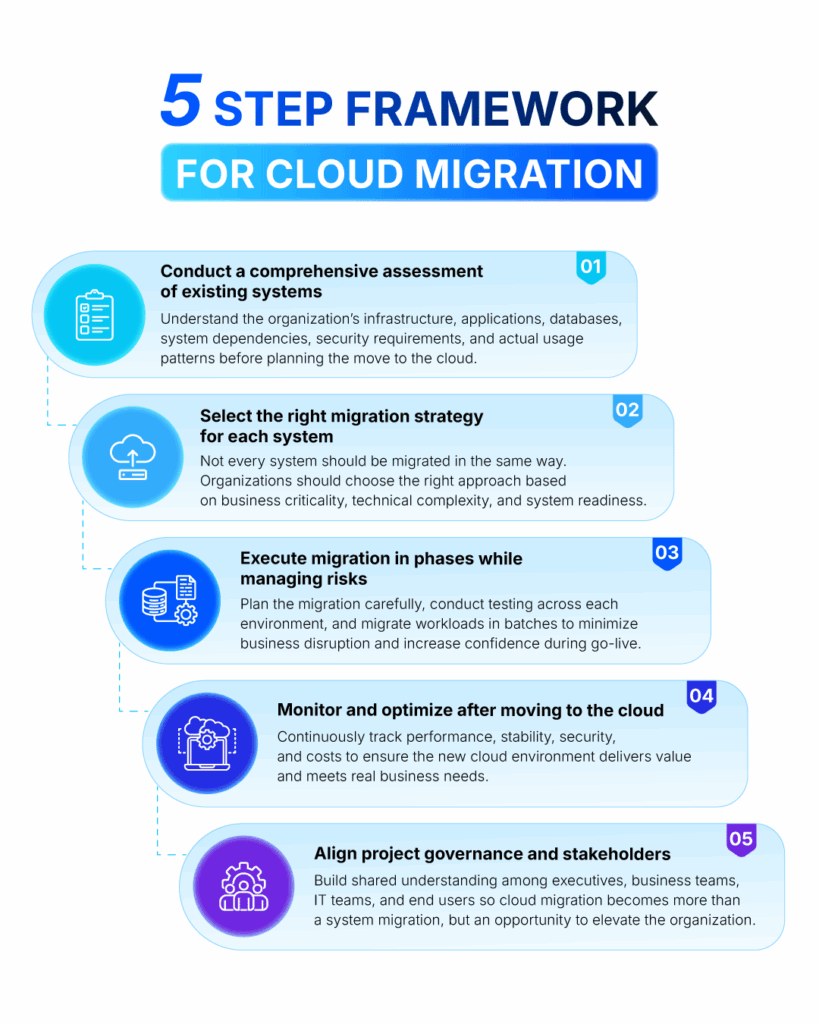
5-Step Framework: Migrating to the Cloud in a Way That Creates Real Business Value
To ensure Cloud Migration is not merely a move to a new environment, organizations need a framework that covers the period before, during, and after migration. This can be structured into five key steps: Assessment, Planning, Execution, Operations & Optimization, and Project & Stakeholder Management. Together, these steps form the foundation for a systematic Cloud Migration journey.
1. Assessment: Clearly Understand What the Organization Has, Uses, and Where the Risks Are
A successful Cloud Migration starts with a comprehensive understanding of existing systems. It should not begin immediately with a list of systems the organization wants to move to the cloud.
Organizations should assess infrastructure, applications, databases, dependencies, and performance baselines to clearly understand which systems are critical to the business, which have technical limitations, which carry risks, and which are ready to be migrated to the cloud.
A strong assessment helps organizations make decisions based on facts, not assumptions. It also reduces the likelihood of issues during migration, such as incorrect system integration, degraded performance, or cloud resources being overdesigned beyond actual needs.
Before moving systems to the cloud, an organization must first understand which systems create value, which systems create burden, and which risks are hidden within the existing architecture.
2. Planning: Choose the Right Migration Strategy
After gaining a complete view of all systems, the organization must plan a migration strategy that fits each workload. A single approach should not be applied to every system, because each system differs in business criticality, technical complexity, level of risk, and readiness for cloud migration.
One useful approach for decision-making is the 7R Migration Strategy. It helps classify systems based on whether they should be migrated, improved, or kept in the existing environment. In this way, Cloud Migration is not about moving everything to the cloud. It is a strategic decision on how each system should be handled to create the greatest business value.
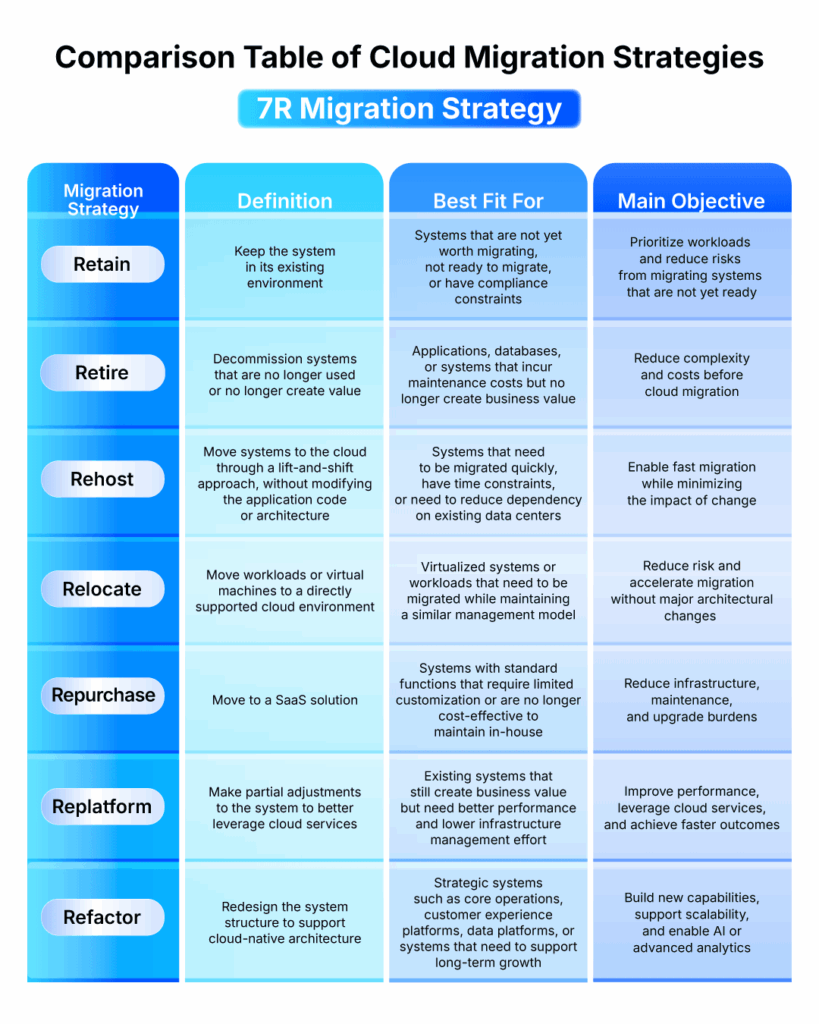
Comparison of the 7R Migration Strategy
| Strategy | Meaning | Best suited for | Main objective |
| Retain | Keep the system in the existing environment | Systems that are not yet worth migrating, not ready to migrate, or have compliance constraints | Prioritize effectively and reduce the risk of migrating systems that are not ready |
| Retire | Decommission systems that are no longer used or no longer create value | Applications, databases, or systems that carry maintenance costs but no longer create business value | Reduce complexity and costs before moving to the cloud |
| Rehost | Move to the cloud through Lift and Shift without changing application code or architecture | Systems that need to move quickly, have time constraints, or need to reduce dependency on the existing data center | Enable rapid migration while minimizing the impact of change |
| Relocate | Move workloads or virtual machines to a directly supported cloud environment | Virtualized systems or workloads that need to migrate while keeping management patterns similar to the original environment | Reduce risk and migrate quickly without major architectural changes |
| Repurchase | Switch to a SaaS solution | Systems with standard functions, limited customization needs, or where self-management is no longer cost-effective | Reduce infrastructure, maintenance, and upgrade burdens |
| Replatform | Adjust selected parts of the system to use cloud services more effectively | Existing systems that still create business value but need better performance and lower infrastructure management burden | Improve performance, capture cloud service benefits, and deliver faster results |
| Refactor | Redesign the system to support cloud-native architecture | Strategic systems such as core operations, customer experience, data platforms, or systems that must support long-term growth | Build new capabilities, support scalability, and enable AI and advanced analytics |
Overall, the 7R framework helps organizations avoid viewing Cloud Migration as moving every system to the cloud in the same way. Instead, it enables them to select the right approach based on the business value and technical complexity of each workload.
However, from the perspective of long-term business value creation, Replatform and Refactor are often two approaches that organizations should consider more carefully for business-critical workloads. They represent a shift from simply “moving systems to the cloud” to “using cloud to enhance efficiency, speed, and business competitiveness.”
Replatform is suitable for organizations that want to improve how existing systems run on the cloud without having to change the core structure of the entire application. Examples include moving to a managed database to reduce database maintenance efforts, using auto-scaling to support changing usage volumes, implementing more structured monitoring and backup, or applying DevOps automation to make development and deployment faster and more stable.
One of the key advantages of Replatform is that it allows organizations to start realizing cloud benefits relatively quickly while keeping change-related risks more manageable than Refactor, as it does not require rebuilding the entire system at once. This approach is therefore suitable for systems that still create business value but need to reduce infrastructure burdens, improve performance, and prepare for future scalability.
On the other hand, Refactor is more suitable for systems with high strategic importance or systems that require significantly new capabilities. These may include systems related to core operations, customer experience, data platforms, or platforms that need to support large numbers of users and continuous feature development. Refactoring may involve redesigning systems toward microservices, containerization, serverless architecture, API-first design, or event-driven architecture, enabling the organization to better leverage cloud-native services.
Although Refactor generally requires more time, budget, and resources than other approaches, when applied to the right systems and managed effectively, it has the potential to generate greater business outcomes in the long term. It can help organizations develop systems faster, scale more flexibly, reduce limitations from legacy architecture, and build a stronger foundation for AI, advanced analytics, and new digital innovations when designed together with the right data architecture, governance, and security.
Therefore, good Cloud Migration planning should not end with the question, “Which systems should we move to the cloud first?” It should go further and ask, “Which systems should simply be moved, which should be improved, and which should be redesigned to create future competitive advantage?” Ultimately, value-driven Cloud Migration does not come from moving everything to the cloud. It comes from choosing the right strategy based on the business impact and technical complexity of each workload.
3. Execution: Migrate with a Plan, Not by Putting the Entire Organization at Risk
Once the plan is clear, the execution stage is about moving systems into the cloud environment in a structured way. This includes configuring infrastructure, preparing the new environment, migrating workloads and databases, adjusting code or pipelines where needed, testing systems, and performing cut-over across each environment.
For organizations with complex systems, a wave-based migration approach, or migrating in batches, helps reduce risk more effectively than moving everything at once. It allows the organization to test, control impact, and learn from each wave before expanding to the next set of systems.
A clear cut-over and rollback plan is also essential, especially for business-critical systems or systems that must provide continuous service.
Cloud Migration is not just about moving servers. It is about ensuring that systems, applications, databases, and integrations all work together correctly, securely, and without disrupting the business.
4. Operations & Optimization: Monitor and Optimize Systems After Migration
One common misconception about Cloud Migration is that the project ends once systems have successfully moved to the cloud.
In reality, business value from cloud becomes clearer after go-live. Organizations must continuously monitor, optimize, and manage systems to achieve the right balance of performance, stability, security, and cost.
Organizations should track metrics such as CPU usage, memory usage, database resource consumption, response time, system availability, and cloud spend. These metrics help adjust resources according to actual usage, reduce unnecessary costs, and improve system stability.
Without post-migration optimization, cloud can become a new cost burden. But when managed correctly, cloud becomes a tool that helps organizations adapt faster and continuously create business value.
Cloud Migration does not end when the migration is complete. It ends when cloud can create real business outcomes.
5. Project & Stakeholder Management: Align the Project and All Stakeholders in the Same Direction
Cloud Migration involves many parties, including executives, IT teams, business units, users, and external partners. Without clear management of goals, expectations, risks, and communication, the project can face obstacles even when the technology is ready.
Organizations should therefore establish strategic project management, or a Strategic PMO, that understands both business and technical perspectives. This function oversees the end-to-end picture, from system assessment and prioritization to risk management, progress tracking, and post-migration outcome measurement.
The goal of Cloud Migration is not only to move systems to the cloud. It is to make the organization more prepared to compete, grow, and respond to technological change.
Technology may make migration possible, but strong management is what makes Cloud Migration truly successful.
Cloud Migration Is a Decision About What Kind of Organization You Want to Build for the Future
As every business faces pressure from competition, technology, and rapidly changing customer expectations, Cloud Migration should not be delayed until legacy systems reach end-of-life or IT costs become uncontrollable.
Instead, it should be a strategic decision that starts with the question: What capabilities does the organization want to build for the future?
If an organization wants to launch new services faster, use data more effectively, truly enable AI, scale systems with flexibility, and manage costs efficiently, building the foundation for Cloud Migration today is an important step.
While some organizations are still deciding when to start, competitors may already be using cloud to create advantage in service development speed, data utilization, and readiness to adopt new technologies.
Ultimately, Cloud Migration is not just about moving systems. It is about moving the organization toward a new level of competitive capability.
The organizations that gain the greatest value from cloud are not always those that migrate the fastest. They are the ones that start with the right framework, deeply understand their own systems, choose the right strategy for each workload, and manage change systematically from beginning to end.