













Converting “Digital Trust” into an Innovation Edge via Zero-Trust AI Access: A Next-Generation Data Governance Framework for the Agentic AI Era

Executive Summary: The Paradox of Innovation and Governance
As artificial intelligence transitions into Autonomous Agents—capable of autonomous data retrieval and delegated decision-making — enterprises are unlocking unprecedented operational velocity. However, this shift introduces a critical paradox: the very autonomy that drives efficiency also creates a massive security blind spot. Without stringent boundaries, “over-privileged AI” exposes companies to critical data breaches and the silent leakage of proprietary corporate intelligence.
To navigate this landscape, Zero-Trust AI Access has emerged as the definitive enterprise benchmark. By modernizing data access controls, organizations can successfully balance rapid AI adoption with bulletproof security, transforming risk management into a sustainable competitive advantage.
The Evolution of Trust: From ‘Trust No One’ to ‘Trust No Machine’

Modern cybersecurity is undergoing a fundamental paradigm shift. Security frameworks must evolve from merely auditing human behavior to validating the underlying cognitive logic of artificial intelligence. As systems grow exponentially complex, enterprise risk management has evolved across three distinct eras:
- Traditional Zero Trust (Human-Centric Security): Anchored by the principle of “Never Trust, Always Verify,” this era focused purely on authenticating user identity and device health to eliminate perimeter vulnerabilities.
- The Rise of Autonomous AI (Agentic Security): With AI agents executing complex data workflows in milliseconds, the threat surface has expanded from identity theft to “visibility overreach.” The black-box nature of AI’s internal reasoning means sensitive corporate data can be exposed through unintended prompt outputs.
- Cognitive Security (Logic-Level Governance): The current frontier demands that Zero Trust principles govern the logical intent behind an AI’s data queries. Scalable, long-term innovation requires granular, context-aware control over machine autonomy.
Strategic Opportunities vs Risks of Zero-Trust AI Access
architecting a Zero-Trust AI Access framework is not just a defensive play; it is a strategic calculation to optimize the “Innovation Equilibrium”—safeguarding corporate valuation while accelerating market velocity.
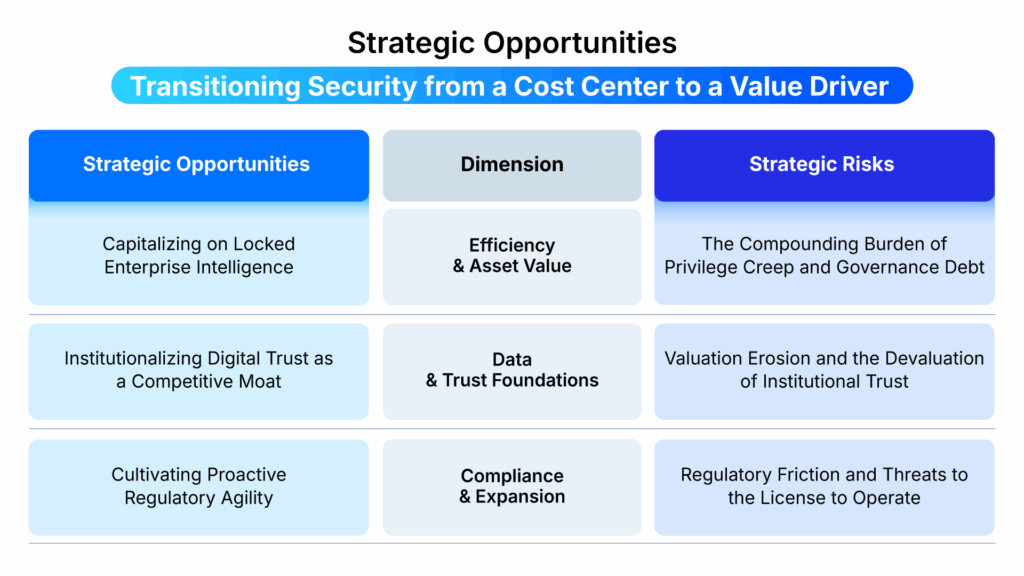
Strategic Opportunities: Transitioning Security from a Cost Center to a Value Driver
- Capitalizing on Locked Enterprise Intelligence: Data stagnation remains a pervasive enterprise challenge. High-value strategic assets—ranging from proprietary manufacturing formulations to M&A blueprints and complex financial telemetry—frequently remain underutilized due to overly restrictive legacy security frameworks. Implementing a granular Zero-Trust AI Access model serves as a vital strategic enabler. It provides the micro-segmentation and precision control required to safely operationalize these high-risk data stores, allowing organizations to capture net-new market advantages without exposing the core business.
- Institutionalizing Digital Trust as a Competitive Moat: Modern enterprise strategy must account for the “Privacy Paradox”—a market dynamic where users demand highly personalized, frictionless experiences yet remain deeply skeptical about data exploitation. Organizations with mature data governance can weaponize this tension into a core value proposition. By elevating basic compliance into an ecosystem of “Trust Arbitrage,” forward-thinking enterprises cultivate unassailable brand equity among institutional partners and premium client segments. This systemic reliability directly yields a financial premium, driving market capitalization and solidifying investor confidence.
- Cultivating Proactive Regulatory Agility: As global AI regulatory frameworks—such as the EU AI Act and sophisticated localized privacy mandates—continue to tighten, a reactive compliance strategy is no longer viable. Investing in a Zero-Trust AI Access architecture today establishes an inherently resilient infrastructure. This proactive posture systematically eliminates future compliance drag, turning regulatory baseline shifts into a friction-free launchpad for cross-border expansion and rapid market entry.
Strategic Risks: Governance Failures and the Cost of Inaction
- The Compounding Burden of Privilege Creep and Governance Debt: The unmonitored accumulation of data access rights—scientifically recognized as “Privilege Creep”—poses an existential internal hazard to modern enterprises. Deep integration of AI agents into core data lakes, without continuous, real-time re-verification, systematically creates permanent, invisible “Super-Users.” Unchecked, this architectural flaw accelerates the proliferation of Shadow AI, saddling the enterprise with compounding governance debt. The ultimate consequence is high-risk exposure to training data leakage, where proprietary secrets are inadvertently absorbed into public models, causing irreversible strategic erosion.
- Valuation Erosion and the Devaluation of Institutional Trust: Data from the Edelman Trust Barometer underscores that trust is the definitive gatekeeper for technology adoption, with trusted organizations achieving up to a 6x higher customer acquisition rate compared to their peers. Conversely, empirical insights from the IBM Cost of a Data Breach report reveal that unmanaged, rogue AI deployments exponentially escalate breach of mitigation costs. This exposure triggers a structural failure in corporate governance that impacts stock prices and enterprise valuation far more severely than legacy IT downtime, precisely because it liquidates the core currency of the modern digital economy: Digital Trust.
- Regulatory Friction and Threats to the License to Operate: Permitting over-privileged AI autonomy within highly regulated sectors—such as financial services, insurance, or healthcare—directly compromises an organization’s foundational “License to Operate.” Compliance failures and systemic oversight deficiencies no longer result in mere administrative adjustments; they actively precipitate immediate operational halts, severe fiscal penalties, and aggressive regulatory intervention. In an unforgiving regulatory landscape, these governance gaps directly jeopardize long-term business continuity and enterprise stability.
Strategic Risks: Governance Failures and the Cost of Inaction
- The Compounding Burden of Privilege Creep and Governance Debt: The unmonitored accumulation of data access rights—scientifically recognized as “Privilege Creep”—poses an existential internal hazard to modern enterprises. Deep integration of AI agents into core data lakes, without continuous, real-time re-verification, systematically creates permanent, invisible “Super-Users.” Unchecked, this architectural flaw accelerates the proliferation of Shadow AI, saddling the enterprise with compounding governance debt. The ultimate consequence is high-risk exposure to training data leakage, where proprietary secrets are inadvertently absorbed into public models, causing irreversible strategic erosion.
- Valuation Erosion and the Devaluation of Institutional Trust: Data from the Edelman Trust Barometer underscores that trust is the definitive gatekeeper for technology adoption, with trusted organizations achieving up to a 6x higher customer acquisition rate compared to their peers. Conversely, empirical insights from the IBM Cost of a Data Breach report reveal that unmanaged, rogue AI deployments exponentially escalate breach of mitigation costs. This exposure triggers a structural failure in corporate governance that impacts stock prices and enterprise valuation far more severely than legacy IT downtime, precisely because it liquidates the core currency of the modern digital economy: Digital Trust.
- Regulatory Friction and Threats to the License to Operate: Permitting over-privileged AI autonomy within highly regulated sectors—such as financial services, insurance, or healthcare—directly compromises an organization’s foundational “License to Operate.” Compliance failures and systemic oversight deficiencies no longer result in mere administrative adjustments; they actively precipitate immediate operational halts, severe fiscal penalties, and aggressive regulatory intervention. In an unforgiving regulatory landscape, these governance gaps directly jeopardize long-term business continuity and enterprise stability.
Governing Agentic AI through the “Zero-Trust AI Access Framework”
Successfully deploying Agentic AI requires moving beyond transactional software procurement toward orchestrating a resilient, adaptive control architecture. To guide enterprises through this paradigm shift, Bluebik has engineered a comprehensive, 4-phase framework designed to transform mature data governance into a core operational differentiator:
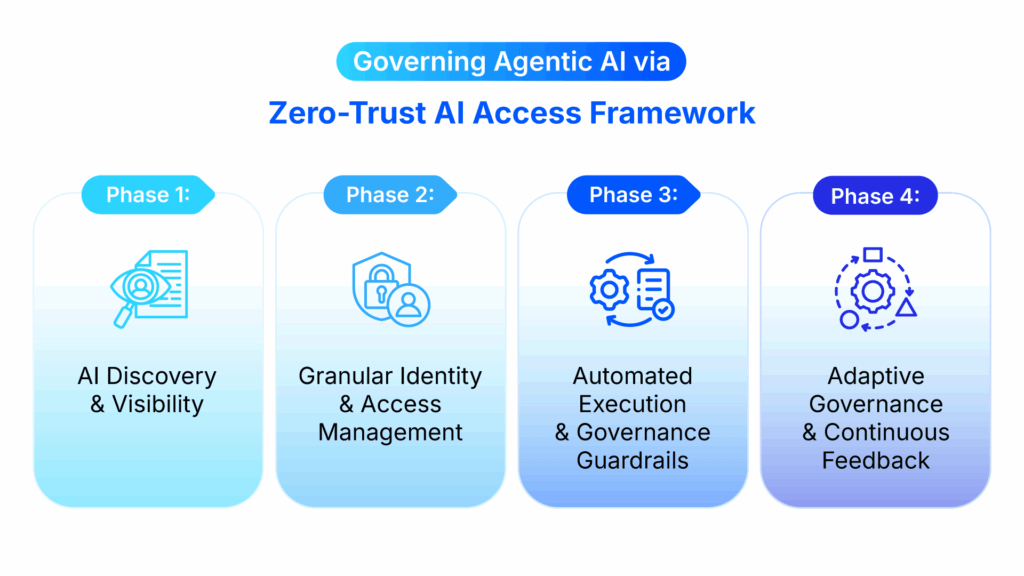
Phase 1: AI Discovery & Visibility
- Strategic Execution & Objective: The foundation of the framework mandates total operational transparency. Establishing an automated AI Asset Inventory enables enterprises to continuously discover, map, and catalog every AI engine interacting with the corporate ecosystem—effectively unearthing both sanctioned corporate applications and rogue Shadow AI deployments. Integrated with rigorous Data Classification protocols, this phase systematically brings latent threat surfaces under centralized governance, neutralizing data vulnerability vectors at the source.
- The Controls Paradox: A critical impediment in this phase is the institutional reliance on rigid, Static Access Restrictions that focus purely on data perimeter isolation. This defensive approach creates immediate friction that chokes AI utility and stunts organizational agility. When operational velocity stalls, the workforce will inevitably bypass corporate guardrails in favor of unsanctioned external tools. This plunges the enterprise into a profound governance paradox: the tighter the theoretical enforcement, the greater the erosion of actual visibility and strategic control.
Phase 2: Granular Identity & Access Management
- Strategic Execution & Objective: Deepening AI integration into proprietary knowledge bases—particularly via Retrieval-Augmented Generation (RAG) architectures—necessitates an immediate paradigm shift from human-centric access controls to object-level data verification. This requires deploying dynamic Identity Mapping protocols, wherein each AI agent is treated as a distinct non-human identity bound rigorously by the principle of Least Privilege. The ultimate objective is to maximize the utility and operational velocity of internal corporate data repositories while establishing an ironclad, context-aware perimeter around sensitive data assets.
- The Flat Access Trap: A major architectural vulnerability in this phase is “Identity Blindness,” a state where the security ecosystem loses the ability to audit the true human originator or contextual intent behind an AI query. This structural gap typically manifests when enterprises grant sweeping, Flat Access parameters to AI models under the guise of accelerating development speed. Consequently, the AI engine inadvertently morphs into a corporate backdoor, enabling lower-level operational personnel to seamlessly extract executive-level insights—effectively neutralizing the enterprise’s entire security posture.
Phase 3: Automated Execution & Governance Guardrails
- Strategic Execution & Objective: Scaling Autonomous Agents capable of executing transactional workflows across disparate legacy systems demands a transition toward context-aware Intelligent Guardrails. Through systematic risk profile segmentation, enterprises can safely delegate end-to-end autonomy to AI engines for low-risk, high-frequency processes (Hyper-automation). Conversely, high-stakes operational pivots must embed uncompromising Human-in-the-loop overrides. This dual-track execution model unlocks autonomous scaling without sacrificing institutional accountability or compromising downstream auditability trails.
- Velocity at the Expense of Governance: The paramount vulnerability in this automated execution phase shifts to External Prompt Injection, an exploit vector where malicious third-party datasets manipulate AI algorithmic logic into unauthorized downstream actions. Prioritizing operational velocity by stripping human validation from Critical Action Points introduces extreme systemic vulnerability. A single algorithmic exploit can instantly catalyze a cascading Chain of Failure across interconnected business networks, rendering immediate isolation and risk containment virtually impossible.
Phase 4: Adaptive Governance & Continuous Feedback
- Strategic Execution & Objective: The final phase institutionalizes a proactive, continuous feedback loop. Deploying real-time telemetry allows the organization to actively monitor AI operational behaviors and intercept emerging anomalies during live execution. These telemetry insights are fed directly back into the core system to dynamically calibrate and modernize security architectures. The goal is to transcend static compliance, evolving the enterprise defense apparatus into a self-improving, adaptive security shield.
- Strategic Lag (The Risk of Outpaced Policies): A critical failure point in this mature phase is the “perception-to-execution gap.” Complacency regarding the perceived maturity of legacy guardrails frequently causes enterprises to neglect continuous risk of re-assessment. Possessing world-class monitoring tools yields zero strategic value if the organization lacks the automated agility to translate telemetry into dynamic policy updates. Without this continuous calibration, once-robust defenses rapidly degenerate into obsolete compliance checklists, leaving the enterprise entirely exposed to rapidly evolving threat vectors.
Global Case Studies: Operationalizing Zero-Trust AI Access
Elevating Security as the New Paradigm for Trusted Innovation
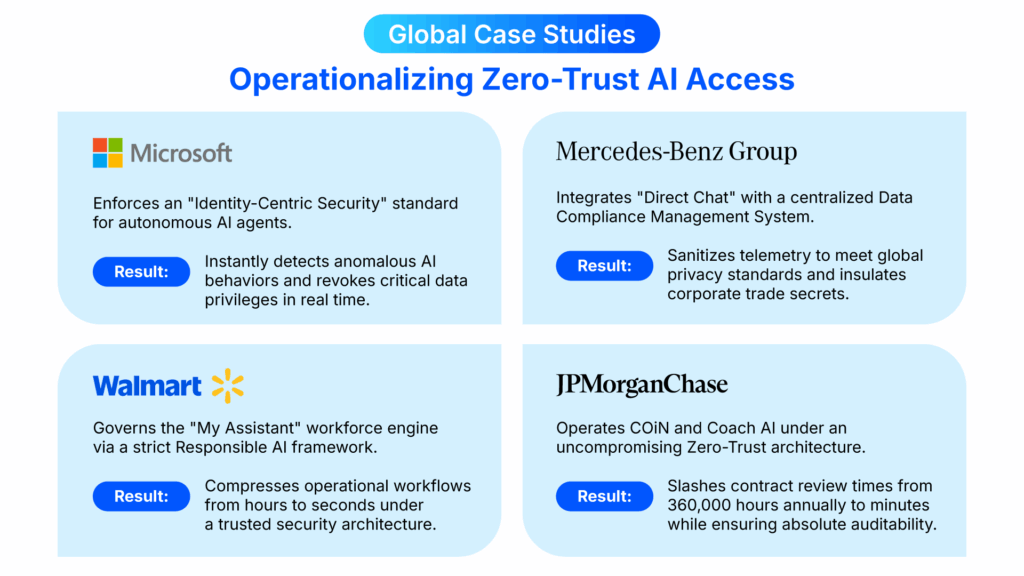
Theoretical frameworks only yield true enterprise value when operationalized. These real-world case studies demonstrate how global market leaders seamlessly align security architecture with AI adoption to eliminate structural risk and drive outsized business performance:
- Microsoft (Identity-Centric Security Standard): Microsoft pioneered an “Identity-Centric Security” blueprint for autonomous agents within its ecosystem. By classifying AI agents as “Non-Human Identities (NHIs),” the enterprise enforces dynamic, real-time access authentication exclusively brokered through Microsoft Entra.
- Strategic Impact: This architecture empowers the system to instantly flag anomalous AI behavior and dynamically revoke data privileges in real time, successfully shifting cybersecurity from reactive damage control to proactive, programmatic containment.
- Mercedes-Benz Group (Proprietary Gateways & IP Insulation): Mercedes-Benz reinforced its data governance by deploying “Direct Chat,” a proprietary enterprise platform integrated with a centralized Data Compliance Management System designed to sanitize and secure corporate intelligence at the ingestion point.
- Strategic Impact: This framework guarantees absolute compliance with stringent global privacy mandates (such as GDPR) while completely neutralizing the risk of corporate intellectual property being ingested as training data by public LLMs, flawlessly securing the brand’s competitive trade secrets.
- Walmart (Productivity at Scale via Guarded Scopes): Walmart amplified workforce productivity through “My Assistant,” a custom-engineered generative AI tool tailored for data synthesis and workflow orchestration, operating rigidly under a Responsible AI protocol that restricts machine access to Approved Data Scopes.
- Strategic Impact: This targeted deployment unlocked secure AI scalability across a massive, decentralized workforce—compressing complex analytical workflows from hours to seconds while the defensive architecture insulated proprietary commercial insights from external exposure.
- JPMorgan Chase (Logic-Level Validation in High-Stakes Finance): JPMorgan Chase revolutionized asset management and corporate legal operations through its COiN (Contract Intelligence) and Coach AI platforms. Both systems operate under an uncompromising Zero-Trust architecture that systematically bars AI engines from accessing core financial systems without real-time security policy validation.
- Strategic Impact: This rigorous governance model compressed intensive legal review processes from 360,000 hours annually to mere minutes, ensuring absolute auditability across all machine-driven decisions and decisively closing the door on over-privileged access risks.
Conclusion: The Bedrock of Trust in the AI Era
In the modern digital economy, cutting-edge innovation rapidly mutates into a profound enterprise hazard if unanchored by a sophisticated security framework. Mitigating AI-driven risk has transcended the boundaries of optional IT initiatives; it is now a non-negotiable boardroom imperative. While global regulatory frameworks continue to lag behind technological velocity, corporate inertia guarantees severe reputational erosion and exposes critical trade secrets within a hyper-competitive landscape where speed, precision, and security dictate market survival.
Ultimately, the velocity of enterprise innovation is strictly governed by the boundaries of its security architecture. Zero-Trust AI Access has established itself as the definitive modern gold standard—effectively operationalizing digital trust to become an organization’s most formidable economic asset.