












In a digital business landscape driven by massive, real-time data streams, Business Resilience has become an urgent strategic priority for executives. Particularly in an era of rapidly shifting business trends, organizations capable of delivering a “faster response” are the ones positioned to capture business opportunities and ensure long-term viability.
For large enterprises, mission-critical applications—the operational backbone of the business—have traditionally been deeply anchored and running on virtualization platforms like VMware for over a decade. Today, however, the push to transition into the Cloud-Native era coincides with a profound market challenge: Broadcom’s acquisition of VMware and the forced shift from perpetual licensing (Perpetual License) to a mandatory subscription model (Subscription). Consequently, legacy infrastructure is no longer just a physical constraint of dragging agility and scalability; it has become an unavoidable, escalating fixed-cost burden.
Consequently, a proactive solution that addresses this challenge and drives true long-term value is not a simple unoptimized Lift-and-Shift migration of workloads, which forces the organization to bear the burden of new licensing fees that escalate dramatically based on the total number of original CPU cores. Instead, it requires executing “VMware Modernization” to transform legacy architecture into a Cloud-Native Infrastructure that delivers genuine efficiency, agility, and maximum cost-effectiveness.
What is VMware Modernization?
In the context of enterprise technology, the scope and definition of “Modernization” is frequently misinterpreted as general cloud migration. A correct understanding of VMware Modernization is therefore a vital starting point, executed across two strategic pillars:
- Hybrid Operating Model Shift: This approach focuses on establishing flexible and automated operational standards that are cloud-like (Cloud-like Operating Model), whether running systems in their own server rooms (On-Premises) or on public clouds (such as AWS). It enables organizations to independently manage Hybrid / Multi-Cloud resources seamlessly through automation (Automation), instead of having to choose between sticking to original servers or being forced to migrate to the cloud 100%.
- Cloud-Ready Architecture Renewal: This strategy aims to improve and upgrade legacy architecture (Legacy Architecture) on a large scale for business benefits, by organizing applications to eliminate excess resources (Zombie VMs) along with refining code to align with cloud strengths, such as automated scaling (Elasticity). This significantly reduces the organization’s hidden costs, unlike standard annual software version upgrades.
The Paradigm Shift: Transitioning from Traditional VMs to the Cloud & Container Era
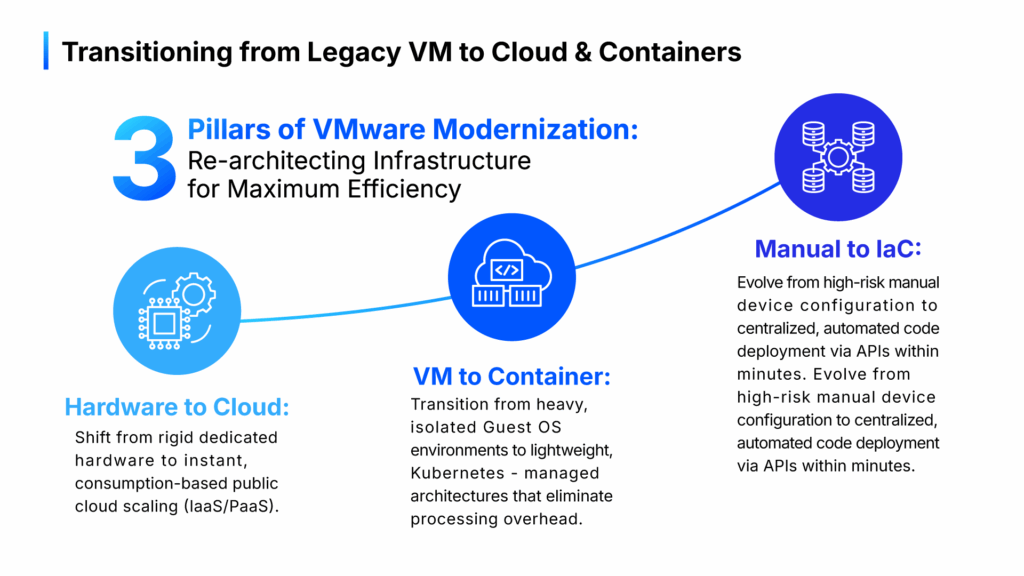
The VMware Modernization strategy aims to reform deep engineering structures to eliminate traditional constraints and maximize the efficiency of cloud technology through three main areas of change:
1. Transitioning to a Software-Defined Cloud to Eliminate Hardware Constraints
- Legacy State: Storage and network systems are tied to dedicated hardware (Dedicated Hardware). Consequently, every time system expansion is required, it requires waiting for procurement and equipment installation processes, which is slow and lagging behind fast-moving business demands.
- New Target: Turning to software-defined infrastructure (Software-Defined Infrastructure) in conjunction with public clouds (IaaS/PaaS). This makes the system flexible, allowing cloud resources to be increased or decreased instantly based on actual utilization.
2. Adopting Containers & Kubernetes to Eliminate Operating System Burden
- Legacy State: Legacy systems isolate each application within a dedicated VM, requiring a complete, standalone guest operating system (Guest OS). This setup drains storage capacity and creates excessive compute overhead.
- New Target: Shifting to container technology (such as Docker) managed by Kubernetes (K8s). By sharing the underlying operating system, containers instantly eliminate resource bloat—rendering the entire system lightweight, highly agile, and perfectly tailored for cloud environments.
3. Centralizing Infrastructure Control via Code (Infrastructure as Code – IaC)
- Legacy State: IT teams rely on manual device-by-device setups (Manual Configuration) for network and security policies—a slow process highly prone to human error (Human Error).
- New Target: Transitioning to centralized software control that manages infrastructure programmatically through automated APIs using code-driven commands (Infrastructure as Code: IaC). This automation applies seamlessly across both local data centers and public clouds, compressing environment deployment timelines to just a few minutes.
The Strategic VMware Modernization Framework
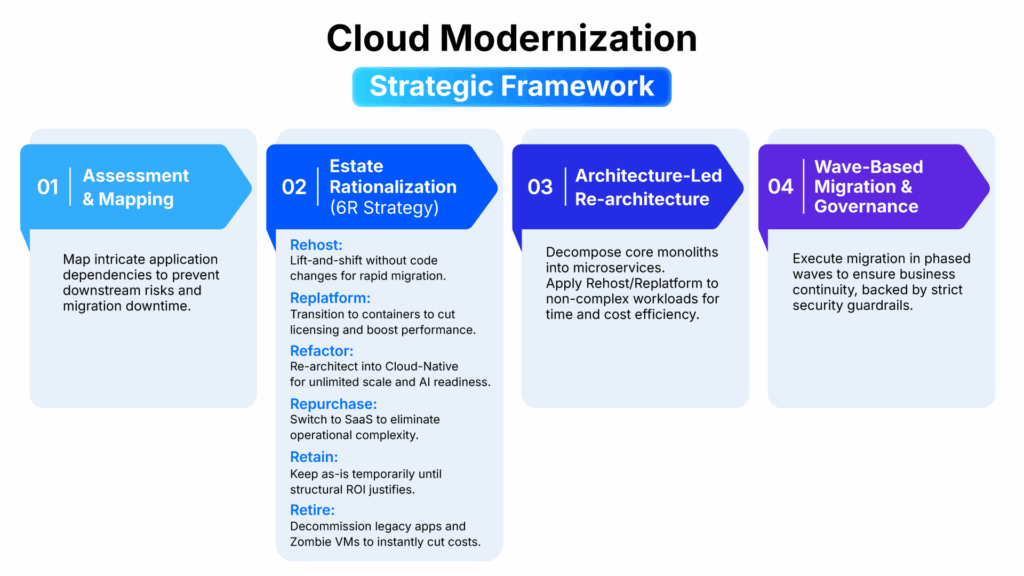
Upgrading system architecture for cloud migration under an optimal budget while controlling risk requires a systematic, four-step framework:
- Comprehensive Assessment & Dependency Mapping: Evaluate the readiness of the existing VMware footprint and conduct an in-depth analysis and mapping of application dependencies to prevent cascading impacts that could cause system failures during migration.
- Structured Estate Rationalization: Organize the entire application portfolio before migration through the globally recognized 6R Migration Strategy to control licensing costs and reduce architectural risks:
- Rehost (Lift and Shift): Migrating the original system without code modifications. This provides speed but risks carrying over inflated subscription fees based on the original Core CPU count if executed without prior infrastructure optimization.
- Replatform (Lift, Tinker, and Shift): Making minor adjustments to suit the cloud—such as moving workloads to containers—to reduce licensing fees and increase efficiency without rewriting core code.
- Refactor / Re-architect (Modernization): Restructuring applications into cloud-native architectures for independent scalability and readiness for advanced technologies like Generative AI.
- Repurchase (Drop and Shop): Transitioning to cloud-native Software-as-a-Service (SaaS) alternatives to reduce complexity and increase management agility.
- Retain (Keep as-is): Maintaining select workloads in their current state temporarily if they are near deprecation or if the immediate Return on Investment (ROI) does not justify migration costs.
- Retire (Decommission): Identifying and shutting down legacy applications and idle “Zombie VMs” to instantly eliminate unnecessary operational spending prior to migration.
- Rehost (Lift and Shift): Migrating the original system without code modifications. This provides speed but risks carrying over inflated subscription fees based on the original Core CPU count if executed without prior infrastructure optimization.
- Architecture-Led Re-architecture: Consider and modify application architecture based on the in-depth suitability of each workload. This phase selectively targets mission-critical applications that require high flexibility and scalability, transitioning them from monolithic frameworks to decentralized Microservices for true cloud-native efficiency. Simpler, static workloads are routed to cost-effective Rehost or Replat form tracks to optimize resource and timeline efficiency.
- Wave-Based Cloud Migration & Governance: Executing migrations in calculated, iterative phases (Waves) to preserve continuous business operations and minimize system downtime, while simultaneously establishing security standards and cloud governance.
Strategic Use Case: VMware Modernization in Action
Studying the success of leading global organizations provides a clear picture of operational outcomes and infrastructure directions, as shown in the following case study:
Case Study: Fidelity Investments – Transitioning Legacy VMs to Multi-Cloud Kubernetes
According to the CNCF case study, Fidelity Investments, a global financial services institution serving over 35 million investors and managing 76 million accounts, transitioned thousands of heavily regulated, mission-critical core financial applications from traditional VM environments to a cloud-native architecture on Kubernetes. This transformation successfully minimized transaction latency and supported massive scalability across three key areas:
- Infrastructure Scaling: Scaled its cloud environment to support nearly 3,000 containerized services running across more than 200 Kubernetes clusters, managing over 10,000 active containers simultaneously.
- Deployment Frequency: Empowered engineering teams to increase feature deployment frequency by 20x compared to traditional virtualization environments.
- Time-to-Market: Automated manual infrastructure provisioning workflows, compressing application deployment timelines from several days down to just a few minutes.
Data validated by global benchmarks on the AWS Cloud Economics portal demonstrates that achieving high cloud-native maturity yields definitive performance gains across four core corporate pillars:
Cloud-Native Maturity Benefits
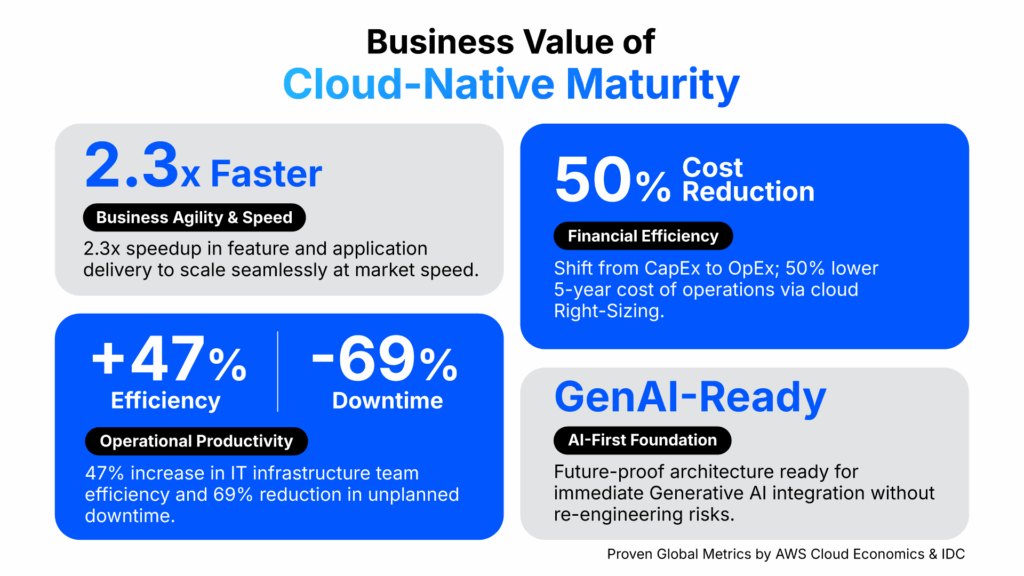
- Business Agility & Speed: Increases the speed of delivering new digital products and features by nearly 2.3 times (Nearly 2.3x), enabling instantaneous enterprise scalability to meet business goals, as outlined by AWS Cloud Economics.
- Financial Efficiency: Converts rigid capital expenditures (CapEx) into fluid operational expenditures (OpEx), reducing the total 5-year cost of operations by 50% (50% Lower 5-year Cost of Operations) through programmatic cloud right-sizing, based on financial metrics from AWS Cloud Economics.
- Operational Productivity: Boosts IT infrastructure team management efficiency by 47% while driving a 69% reduction in costly, unplanned system downtime, according to independent IDC research hosted on AWS Cloud Economics.

- AI-First Foundation: Establishes a highly flexible digital architecture that allows the enterprise to seamlessly connect cloud data pipelines directly into advanced Generative AI applications without incurring future redevelopment costs.
Technical Challenges and the “Skills Gap” Paradox
While upgrading systems yields cost-effective returns in the long term, the modernization process is an advanced IT engineering task with multiple challenges. Without comprehensive planning and assessment, differences in storage and networking behaviors between the original system and the new cloud environment can lead to mis-sizing of resources or cause system downtime because original system dependencies are broken (Broken Dependencies).
This execution risk is intensified by a deep industry talent misalignment—The Critical Skills Gap—where IT engineering capabilities are sharply divided:
- System Administrator (Legacy Infrastructure Focus): Maintain deep expertise in local physical environments, enterprise networks, and traditional storage architectures (SAN Fabric, LUNs, RAID). However, they frequently lack hands-on experience in programmatic system automation, and modern software development is required to control public cloud fabrics.
- DevOps / Platform Engineer (Cloud-Native Focus): Excel in modern automation pipelines, CI/CD, containers, and public cloud orchestration. However, they do not yet fully understand low-level legacy hardware constraints, hardware-driven latency profiles, or possess direct experience in migrating complex legacy systems.
Consequently, the success of migrating VMware environments to the cloud safely and smoothly depends entirely on having a team that truly bridges and understands the technical realities of both domains.
The “Right” Partner: The Linchpin of VMware Modernization Success
VMware Modernization to Cloud initiatives entail profound structural complexities that extend far beyond conventional IT management paradigms. To succeed, enterprises must rely on a Strategic Tech Partner possessing “Hybrid” Capabilities—bridging Deep Infrastructure Knowledge of legacy VMware ecosystems with Broad Cloud & DevOps Knowledge to architect next-generation cloud environments driven by end-to-end automation.
A high-caliber partner must deliver a comprehensive, 3-dimensional approach to seamlessly transition the enterprise into an AI-First era:
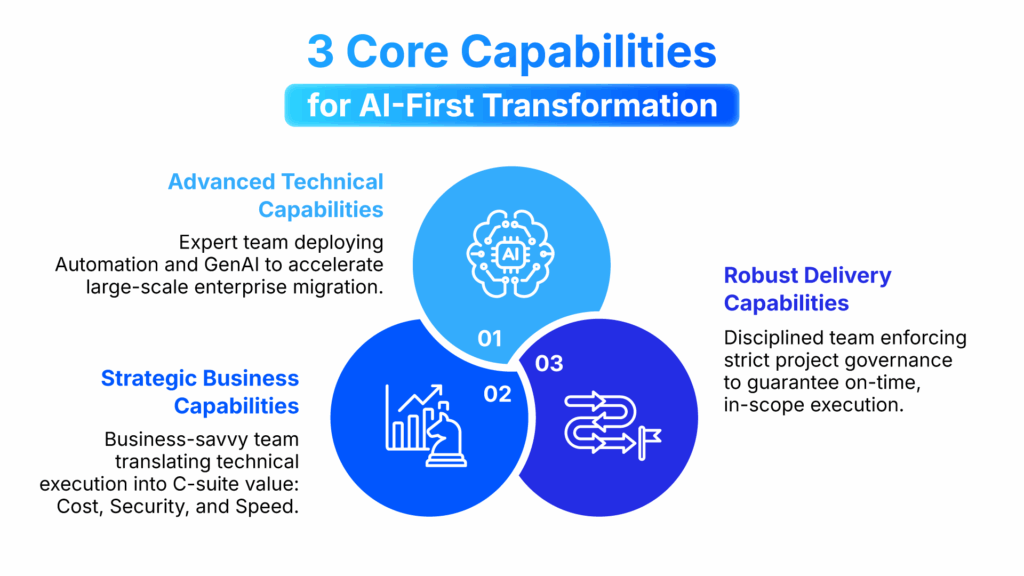
- In-depth Technology: Elite technical squads capable of leveraging advanced technologies like Generative AI—specifically utilizing market-leading tools such as Amazon Q Developer within an Agentic Development framework—to significantly accelerate delivery timelines and manage large-scale migrations.
- Business Strategy: The capability to translate technical milestones into tangible corporate metrics, ensuring alignment with core business imperatives such as cost optimization, robust security, and competitive market velocity.
- End-to-End Delivery: Standardized, framework-driven processes and rigorous project governance models that guarantee precise and complete execution within defined timelines.
Selecting a partner with this multidimensional expertise is a critical imperative for transforming legacy environments into cost-optimized, highly secure cloud powerhouses. Bluebik, as a premier end-to-end digital transformation consultancy, empowers enterprise-level organizations through our End-to-End Cloud Strategy & Infrastructure Modernization suite, encompassing:
- Comprehensive Assessment: Deep-dive evaluations of complex system dependencies.
- 6R Rationalization: Application portfolio optimization engineered to mitigate per-core cost risks.
- Cloud-Native Re-architecture & Cloud Governance: Modern structural redesign paired with robust governance frameworks to drive sustainable corporate growth.
Fortify Business Resilience and Future-Proof Your Enterprise Infrastructure Today
Engage Bluebik’s cloud strategy and technology advisory team to secure your Infrastructure Readiness Assessment and co-create a transformation strategy tailored for maximum business value.