













In a fast-moving work environment that rarely slows in the face of uncertainty, every team eventually needs someone to act as its anchor. Someone who isn’t just good at planning, but grounded enough to turn any challenge that surfaces into something manageable.
At Bluebik, that someone is a whole team. They’re called Strategic PMO.
Think of them as the glue and the gears that keep every project moving forward. They’re the people who take on the tough problems and collaborate with stakeholders across industries.
When facing the varied demands of different clients, the team agrees on one thing: the core of being a great PMO is staying composed enough to handle any situation, no matter how complex. And that level of excellence doesn’t happen overnight. It’s built slowly, through accumulated experience and real-world learning.
In this edition of our X Factors series, where we explore the excellence that drives each team at Bluebik, we sat down with Paeng (Manager, Strategic PMO), along with Eiffel, Deng, and Peach (Consultants, Strategic PMO), to talk about the X Factors that define their team: what drives them to deliver projects successfully while building trust with everyone around them.
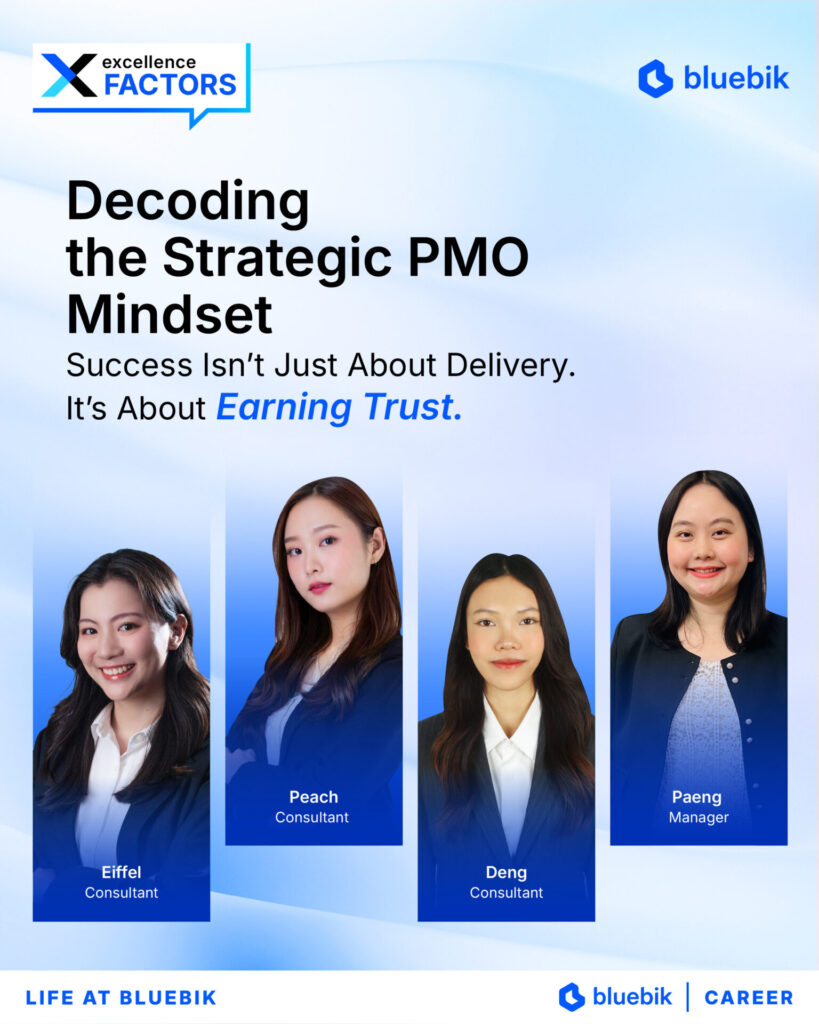
The eXcellence Team: Getting to Know PMO
Before diving into their excellence factors, let’s make sure we’re on the same page about what PMO actually means.
A PMO, or Project Management Office, is the function within an organization responsible for managing large-scale projects. It sets the standards, methodologies, tools, and techniques that keep project execution consistent, efficient, transparent, and lower-risk.
A common question is whether a PMO works the same way as a PM (Project Manager). The short answer: both deal with project management, but at very different scales. A PM owns a single project, handling planning, resource allocation, budget control, and risk management until delivery. A PMO, on the other hand, operates across multiple projects, sometimes all of them, with responsibilities spanning from strategy to operations. The focus is on the big picture: setting policy, improving processes, and reducing risk at an organizational level.
The eXcellence Factors: 4 Pillars of Excellence
Bluebik’s PMO team has more than 20 members.
By nature, the PMO structure is decentralized. Since most client projects require only one or two PMO members on-site, everyone operates independently across their assigned projects. But even without working side by side daily, a shared set of values holds the team together. Their X Factors, or Excellence Factors, define what it means to be great in this role.
When asked to define those factors, the team didn’t settle for just one word. They came up with four.
1. Soft Skills
This is the foundation of any PM or PMO. Soft skills might sound like a catch-all term, but they cover a lot of ground: communication, teamwork, leadership, problem-solving, and emotional self-management.
Peach explains it this way: “We are the people whose job is to drive projects to completion. We’re the gear that keeps everything moving toward the goal. And soft skills are the small things that make all of that possible.”
So, how do you build soft skills? The team is clear: you can’t study your way into them. They come from doing the work, making mistakes, and trying again across different projects, industries, and client types. Some of the best lessons come when things don’t go as planned.
“It’s continuous learning by doing, across projects, industries, and all kinds of clients,” Peach adds.
2. Adaptability
A PMO team has many tools in the playbook, but choosing the right one for the right situation is what actually matters. Something that worked on one project might not work on the next. That’s why the ability to read a situation and adapt is non-negotiable.
Paeng breaks it down: “Adaptability looks different depending on the situation. Since every project and client is different, sometimes clients bring their own way of working, and we have to adjust alongside them. That might mean finding the right middle ground, reading the context carefully, and choosing the solution that fits.”
3. Management Skills
The PMO team sits at the center of multiple stakeholders, bridging the gap between tech and business. That position requires strong management skills, whether it’s managing work or managing people.
Eiffel puts it plainly: “Any given project involves a wide range of stakeholders from both the tech and business sides. We have to approach each person the right way to get results and keep the project moving forward. Learning how to engage with people, adjust how you communicate based on who you’re talking to, and understanding what each person is actually trying to get out of this, that’s what makes the difference.”
4. Trust
Especially trust from clients. Trust doesn’t appear out of thin air. The PMO team earns it by consistently showing up and delivering, both with clients and colleagues. When they get it right, that trust grows over time.
Deng shares her perspective: “I see PM and PMO as the glue between teams. That means our first job is to build confidence in the team and in the client, so that we can coordinate, communicate, and help solve problems.”
“In every project, clients sometimes don’t fully open up to you right away, because you’re the new person coming into their space. But over time, as you keep showing up and doing the work, they start to see that you’re here to make things run smoother. That’s how trust is built.”
The eXcellence and The BLUE: 4 Pillars of Excellence at Bluebik
Zooming out to the organization level, Bluebik has its own set of X Factors that reflect the company’s standard of excellence. They’re captured in the word BLUE:
B stands for Beyond Standard. Not just finishing the work, but truly delivering it.
L stands for Lead by Action. Bringing creative thinking to life.
U stands for Unity in Diversity. Building an organization that brings together people with a wide range of backgrounds and experiences.
E stands for Empathy and Empower. Leading with empathy and always lifting the people around you.
When we asked the PMO team if these values show up in their day-to-day work, Paeng didn’t hesitate: all four, she said. But E stands out most, since empathy is at the core of how the team works with clients and each other.
“Our team and our clients come from very different backgrounds with different perspectives. So we communicate with the intent to actually understand: what does each side really need? Then we work from there to figure out how to make it happen.”
Eiffel adds her take: “I absolutely agree that E is critical for PMO. We work with a lot of people, and when something gets stuck, we need to go in and figure out exactly where the delivery broke down. B also matters a lot to me because we want to manage projects to meet clients’ needs, or ideally, go beyond them. When we do that, it circles back and builds the Trust that’s one of our core X Factors.”
The eXcellence Culture: A Culture That Keeps People Growing
Beyond learning through the work itself, Bluebik also sends PMO team members to specialized Project Management training programs, where they can earn formal certifications. And within the team, internal training sessions are held regularly to help everyone keep building their skills.
But as we mentioned, everyone on this team tends to work independently, spread across different projects and client sites.
Paeng laughs as she puts it: “People in this team barely see each other. But we stay connected by getting together for a meal every three months, usually catching up on how projects are going. More formal touchpoints happen at company events, team meetings, or outings. Since we work on a project basis, everyone runs their own projects, but we always have mentors to turn to.”
Beyond casual catch-up meals, the team holds dedicated Knowledge Sharing Sessions where members share hands-on learnings from completed projects, a structured way to pass experience across the team.
“Everyone has their own story and their own set of experiences from very different projects. When we share those, it becomes a shortcut for the rest of us,” says Peach. “It’s like the seniors have figured out what works, and they’re passing that down.”

The eXcellence Conversation: On Work, Success, and Life as a PMO
With the team in one room, we couldn’t miss the chance to dig deeper into the mindset behind their work. We asked all four to open up about how they define success beyond project outcomes, how they handle pressure, and what it takes to set their own bar higher than expected.
If you’re looking to level up in this field, you might find the answers in what they shared.
You all work independently on different projects. Does the PMO team share a common definition of “success”?
Peach: “Success is actually a hard word to pin down, but the one that comes to mind for me is ‘Go Live.’ That’s the term we use when a project has reached its goal, after we’ve spent months developing the software, application, or system, and we finally hand it over to the client smoothly. That’s our version of a win.”
Deng: “Beyond the project succeeding, I think ‘people succeeding’ matters just as much. What I mean is being able to maintain the relationship with your client and your team. Because when one project ends, you might cross paths again on another. If things ended badly, they might not want to work with you again. So maintaining strong relationships is just as important as hitting the deliverables.”
What is the one thing the PMO team refuses to compromise on, no matter what?
Peach: “Quality is something we really can’t let slide. Going back to what Deng said about Trust being a core X Factor, if we commit to something, we want to deliver it well. If the quality isn’t there, everyone loses: the client, the team, and the organization.”
Paeng: “In managing any project, we balance three key factors: Time, Resources, and Scope. We start by assessing the timeline, then decide whether to reduce scope or add resources. If resources are limited, we communicate transparently with all parties to find a solution. If time is tight, we might adjust scope by deprioritizing non-critical features so the quality of core deliverables isn’t affected. At the end, a project’s success depends on how well the team communicates and manages client expectations.”
Does holding yourselves to these four X Factors (Soft Skills, Adaptability, Management Skills, and Trust) ever create pressure?
Peach: “I see all four as the fundamental skills of being a PM and PMO, so I’m always trying to maintain them. There can be pressure, sure. But I keep reminding myself that we are professional PMOs being paid to deliver value. We don’t want clients to ever wonder, ‘What does PMO actually do here, and why do we need them?’”
Paeng: “Work changes constantly, and new clients keep coming. When stress hits, I focus on taking care of myself and remind myself this is work, but there’s another part of life to enjoy and decompress. It’s a normal part of the job.”
If an intern or a junior asked you how to get to where you are, what would you tell them?
Peach: “The first thing I’d say is understand the project context. If you enter a project without knowing what it aims to accomplish or needs, you won’t be able to do Project Management. That’s step one. After that, you need to understand what each stakeholder wants from the project.”
Paeng: “Building on what Peach said, you also need to be broadly curious. We don’t get to choose our industries. One project might be in banking, the next in petrochemicals. If you’re not someone who genuinely wants to learn, you’ll struggle to grasp the context of each industry. So an open, curious mindset is non-negotiable.”
Looking back on your time in this team, what’s the most important lesson you’ve learned, and how has it helped you grow in this career?
Peach: “I’ve learned that there’s nothing I can’t do. When I first joined as a Junior PM, I genuinely couldn’t picture myself running the kind of projects my seniors were managing, projects worth hundreds of millions. But they always said, “If we can do it, you can do it too.” That stuck with me.”
Paeng: “Being in PMO gives you an incredibly wide range of experiences, technical, technological, and beyond. It turned me into someone who genuinely loves learning all the time.”
Eiffel: “Working across so many industries gave me the chance to discover where I actually want to go deeper. Now I know which industries I enjoy, and I can focus on building expertise there. One day, I might specialize as a PMO in a specific sector.”
Deng: “I agree with everyone. PMO work gives you the big picture of your career and what you actually want to do with it. Once you have that view, you can choose which part to zoom into, and go all in on learning it.”
PMO is a career path built for people who thrive on challenges, stay curious, and know how to manage both work and people. If that sounds like you, and you’re ready to build something great with Bluebik, don’t wait. Apply here: https://bluebik.com/th/job/project-management-consultant-2/